
-Alec Schibanoff
It was just 180 years ago that one Carl Benze filed a patent application for a "Gas-Powered Vehicle." He was granted German Patent DRP 37435 and nothing has been the same since. Benz's first car was a three-wheeler.
However, shortly before that, in 1885, another German, one Gottlieb Daimler, filed a patent application for a "Riding Car." It had only two wheels, so it became the prototype for what was to become the motorcycle. When Benz introduced a larger, four-wheel model automobile, he named it after his daughter, Mercedes. Years later, Benz and Daimler decided to join forces, and the successor was the venerable Daimler-Benz AG. When Daimler-Benz bought Chrysler, it became DaimlerChrysler AG, and when the company spun off Chrysler, Carl got squeezed out and it became the Daimler AG. It took the name Mercedes-Benz Group AG in 2022 and it assembles over two million passenger vehicles and trucks a year.
As is almost always the case, however, America was first. One George Selden beat Carl Benze to the patent office – in this case the U.S. Patent Office – when he filed a patent application in 1879, seven years prior to Herr Benz's filing. However, U.S. Patent No. 549,160 for a "Road Engine" was not issued until 1895. One cannot blame the Patent Office or blame the 16-year pendency of Mr. Selden's patent application on prior art issues. Some believe that Selden purposely delayed the issuance of the patent because he was not ready to start manufacturing, and he wanted to delay issuance of the patent until he was.
There are not too many Seldens on the road, but there lots of Fords. Henry Ford chose to NOT license the Selden patent when he introduced the Model T. Ford was sued by Selden for patent infringement. He lost on the first round, but Ford appealed the initial court ruling and won on the basis that Selden's patent called for a two-cycle engine and Ford used a four-cycle engine. Gotta read those claims! Selden is out of business while the Ford Motor Company sells over two million cars and trucks a year.
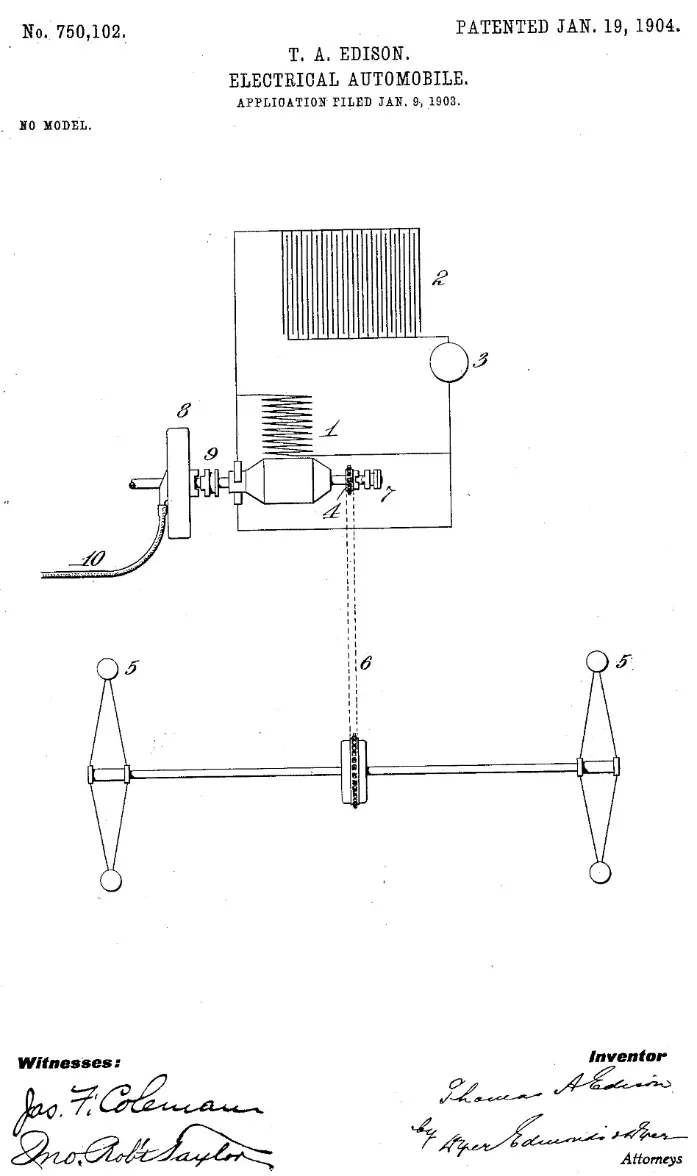
Benz’s, Selden’s, and Ford’s cars were all gasoline powered. What about electric vehicles? It was a tortuous trip for electric autos with many fits and starts. One of the first and most powerful proponents for electric vehicles was none other than Thomas Edison. Although he and Henry Ford were fishing and hunting buddies, they were direct competitors in the automobile business. In 1903, the same year Ford launched the Model T, Edison was awarded U.S. Patent 750,102 for an “Electrical Automobile.”
The first electric vehicles were available before gasoline vehicles – as early as the 1890s, a decade before the introduction of the Model T. Edison heavily promoted an electric car, but the challenge then, as it still is today, was range. The longer you can drive your EV on a charge, the more practical the vehicle is. Realizing the limited capacity of lead-acid batteries, Edison developed a nickel-alkaline battery that was much more durable and far less hazardous than its lead-acid predecessors. Unfortunately, the new battery was also larger and more expensive than the conventional lead-acid battery, so it significantly increased the cost of an electric vehicle over competing gasoline vehicles. Not much has changed in 130 years!
One of the early advantages of the electric vehicles was easy-of-starting. Like a coffee pot, you just turn them on and drive away. If you owned a Ford, Oldsmobile, or Pierce-Arrow (the best-selling cars in 1910), you had to set the choke and advance, get out of the car, get out the crank, insert it, and turn the crank in the hope the car would start – and you would not throw out your back or break your arm in the process. When the auto industry offered an electric starter in 1912, it was a significant advancement for gasoline-powered cars and major set-back for electric vehicles.
Information for this article was supplied by IPOfferings LLC, a leading patent broker and provider of patent valuation services.
