
Why does a house in northeast Bakersfield sit at 79 degrees all afternoon while the condenser outside runs without a break? Ask any hvac contractor bakersfield ca homeowners call in July, and the honest answer usually points at the duct system overhead. The equipment on the slab gets blamed first because it is the part you can hear. Air that never reaches the back bedrooms cannot cool them.
Airflow Fails Long Before The Equipment Does
Cooling is a delivery business. The compressor and coil pull heat out of the air, and the ducts carry that cooled air to the rooms where people actually sit. When a return is undersized or a flex run is crushed behind a truss, static pressure climbs and the blower moves less air. The whole chain weakens even though every component still technically works. What usually turns up on a summer service call is a system that looks fine on paper and is starved in practice. A system that cannot move its rated airflow will never deliver its rated efficiency. Nobody enjoys hearing that after paying for new equipment two summers ago.
California Kilowatt Hours Are Too Costly To Waste
Wasted air stays a nuisance until you look at the rate you pay for it. Federal price data puts California residential electricity near 35 cents per kilowatt hour this spring, close to double the national average of 18.8 cents. That is higher than every neighboring state in the West. A duct system dumping a quarter of its air into a 140 degree attic is no rounding error on that bill (if your July statement has ever made you swear out loud on the porch, this section is for you). The attic quietly eats the difference while the thermostat keeps calling for more.
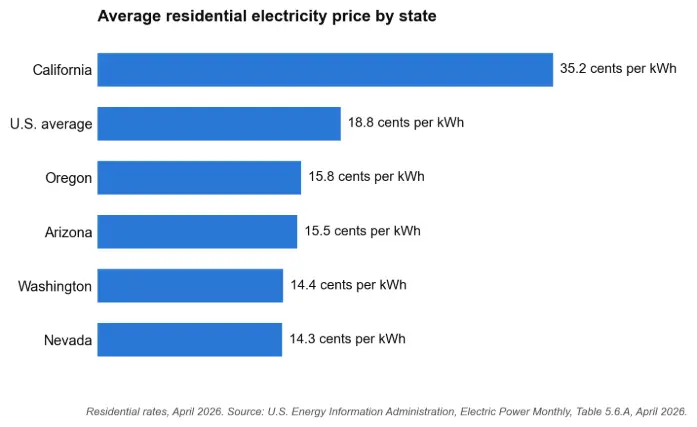
The wholesale side has actually been easing off lately. The Energy Information Administration pegged summer wholesale power at about $45 per megawatt hour nationally in its July 2026 short term outlook, with the largest declines in the western hubs. Retail bills in Kern County have not followed, and they rarely do in a hurry. That leaves homeowners one lever they fully control, which is how much of the air they pay to cool actually arrives in the room.
Duct Design Beats Equipment Size Every Time
Ten years ago the standard fix for a hot house was more tonnage. A three ton system struggling in a 1,700 square foot tract home became a four ton system, and the homeowner paid maybe two thousand dollars more for capacity the ducts could not deliver. The measuring, if it happened at all, came afterward. Today a good crew reads static pressure at the air handler, checks the temperature split across the coil, and calculates airflow per ton before anyone writes a proposal. The instruments got cheap and the trade got smarter about what they reveal.
Design rules for the duct itself are not mysterious either. An HVAC engineer writing in Contracting Business argues that a well built residential run should have fewer than three turns, a smooth interior surface, and sealed joints, citing NFPA 90B as the residential standard behind that guidance. Plenty of Bakersfield homes built in the 1980s and 1990s got none of it, and the crushed return in the hallway is often still the original one. Any hvac contractor bakersfield ca homeowners hire should be willing to show those readings before quoting a replacement.
An Indoor Heat Problem Is A Health Problem
There is a point where a warm house stops being a comfort complaint. Researchers publishing in Environmental Health Perspectives put sixteen older adults through eight hour exposures to indoor summer conditions. They reported that core temperature rose 0.7 degrees Celsius at 31 degrees C while 26 degrees C left it essentially flat, which is why the authors support a 26 degree indoor ceiling for vulnerable occupants. That works out to roughly 79 Fahrenheit, and their trial ran in Ontario rather than the southern San Joaquin Valley. Treat the number as a conservative reference, not a promise about a Kern County August. The practical point still holds up. If an older relative in a hot house becomes confused, stops sweating, or starts vomiting, call 911 immediately and start cooling them while help is coming.
Fix The Airflow Before Buying New Equipment
Measure first, then take a quote. A duct leakage test, static pressure readings at the air handler, and an honest walk of the attic runs will usually separate a capacity problem from a delivery problem. That work takes under two hours, and the answer changes what you should spend. Ask for the readings in writing rather than a verbal summary at the door. Sealing and re-supporting the ducts in a 1,700 square foot home costs a fraction of a full changeout. It also makes whatever equipment you eventually buy behave the way its label promised. The house that would not drop below 79 tends to hold 74 afterward, with the same condenser sitting on the same pad.
