
Mary Musgrove (Coosaponakeesa, c.1700–1765) wore a deliberately bicultural set of accessories — Creek shell gorgets, wampum bead necklaces, copper bracelets, and feather adornments for her Indigenous identity, plus trade-silver brooches, silk ribbons, lace trim, and imported earrings for her role in colonial Georgia. No single inventory of her personal belongings survives. But her life as a Wind Clan Creek woman, a prosperous trading post owner, and the principal interpreter for General James Oglethorpe gives us everything we need to reconstruct her adornment with high confidence. This article does exactly that — drawing on archaeological finds from the 2002 excavation of her Cowpens trading post, documented Southeastern Creek material culture, and 18th-century colonial fashion records.
Who Was Mary Musgrove? The Context You Need First

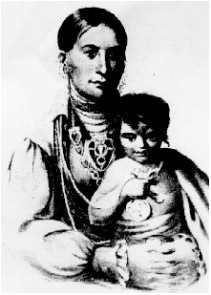
Mary Musgrove (Coosaponakeesa) — Creek Wind Clan member, trading post owner, and the woman without whom Georgia might not exist as we know it. Image: Georgia Public Broadcasting.
You cannot understand what Mary Musgrove wore without first understanding who she was at each stage of her life. Her accessories were never random. They were a deliberate statement of identity, authority, and diplomacy.
c.1700 in Coweta, Creek Nation (modern Macon, Georgia). Creek name: Coosaponakeesa ("lovely fawn").
Wind Clan (Muscogee Creek). Matrilineal society — her mother's clan defined her identity, not her English father.
By the 1730s, wealthiest woman in Georgia Colony. Ran the Cowpens trading post and controlled the deerskin trade.
Principal interpreter for General James Oglethorpe, 1733–1743. Earned £100 sterling per year — a fortune at the time.
In 1739, she received a bolt of Georgia's first silk — the same gift sent to the Queen of England.
1765, St. Catherine's Island, Georgia. Three husbands. Owner of thousands of coastal Georgia acres.
According to historian Steven Hahn, author of The Life and Times of Mary Musgrove (University Press of Florida), historical depictions of Mary "in traditional Indian dress" as a "submissive princess" are not accurate portrayals. She was a powerful businesswoman whose clothing and accessories reflected real economic and political power.
Creek Accessories Mary Musgrove Wore: The Indigenous Layer
Mary Musgrove was a full member of Creek society despite her mixed heritage. In the matrilineal Creek Nation, children took their mother's clan identity. That made her 100% Creek in the eyes of her people — and her accessories reflected that completely.
Wampum — made from quahog clam and whelk shells — served as both personal adornment and a carrier of diplomatic meaning across Southeastern tribes including the Creek Nation.
1. Shell Gorgets — Her Most Powerful Accessory
A gorget is a flat pendant worn at the chest, carved from Gulf Coast conch or whelk shell and engraved with ceremonial imagery. In Creek and broader Southeastern Mississippian culture, gorgets were the mark of status and leadership.
- Material: Gulf Coast whelk or conch shell, sometimes brass or silver after European contact
- Design: Engraved with mythological figures, the sacred fire symbol, falcon imagery, or four-winds scrollwork
- Worn by: Women and leaders of high rank — exactly Mary Musgrove's position
- Significance: "Shell gorgets served as prominent chest ornaments, often featuring intricate motifs... denoting status and buried with elites" — Native American Jewelry, Wikipedia
- Trade version: After European contact, metal gorgets became prized trade goods. Mary's access to the deerskin trade would have given her first pick of imported silver gorgets
2. Wampum Bead Necklaces and Bracelets
Wampum was the most widespread accessory among Southeastern and Northeastern tribes. For the Creek, wampum was both personal jewellery and a carrier of diplomatic meaning.
- Material: Cylindrical beads drilled from quahog clam (dark purple) and whelk shells (white)
- Form: Worn as necklaces, bracelets, belts, and collar strands
- Diplomatic function: Creek confederacies "exchanged strings or belts of wampum to solidify negotiations" — Northern Cherokee Nation
- Mary's context: As a peace negotiator between the Creek and the British, she would have been deeply familiar with wampum's communicative power and worn it accordingly
- Historical record: Period observer Joseph Hadfield (1785) documented that Southeastern women wore "a broad necklace of wampum of shells turned into small cylindrical forms"
3. Copper and Shell Bracelets
Copper was worked by Southeastern tribes long before European contact. Period sources confirm that women wore "bracelets on their wrist made from copper or shells" (Barbara R. Duncan, Cherokee Clothing of the 1700s, p.25). After European trade, silver replaced copper as the prestige metal of choice.
4. Shell and Pearl Necklaces
Pre-contact Creek women wore necklaces made from:
- Columnella shell — from the inside of conch shells
- Olivella and marginella shells
- Bone and small worked shell beads
- Freshwater pearls (rare and high-status)
Period records compiled by historian Barbara R. Duncan confirm these as the standard necklace materials for Southeastern tribal women in the 1700s.
5. Ear Spools and Earrings
Creek women wore ear jewelry in multiple forms. Traditional styles included ear spools (round plugs worn in stretched piercings) made from stone or wood. After European contact, metal loops with bead or shell pendants became popular. Given Mary's wealth, she likely wore silver trade earrings by the time she was operating the Cowpens post in the 1730s.
6. Featherwork — Ceremonial Occasions
For formal Creek ceremonies or tribal gatherings, southeastern women incorporated featherwork into their adornment. Turkey feather elements, in particular, held ceremonial significance across Creek and related tribes. Mary would have reserved these for specifically Creek-facing occasions.
Colonial European Accessories: The English Layer

Trade-silver brooches were among the most sought-after accessories at English-Indian trading posts in colonial Georgia — exactly the goods Mary Musgrove sold and wore.
Mary Musgrove spent her childhood in South Carolina's English colony at Pon Pon. She was baptised, educated in English, and married English traders — three times. Her home in Savannah received visits from the Anglican rector John Wesley, General Oglethorpe, and other prominent colonial figures. In those settings, European-style accessories were a social necessity.
1. Trade-Silver Brooches
This is probably the most historically certain European accessory Mary owned. Silver trade brooches were the defining accessory of the English-Indian trade economy. Mary's Cowpens trading post was the leading hub for exactly these goods. Period sources confirm that Southeastern women of high status wore "corals, small crosses, little round escutcheons, and crescents, made either of silver or wampum" (historical traveller account, compiled in 1700s Woodland Women, Weeya Calif).
2. Lace Trim and Silk Ribbons
European women's fashion in the early 18th century used lace trim, silk ribbons, and decorative aprons to signal status. Mary's remarkable rise to become the wealthiest woman in the Georgia Colony — and the recipient of the colony's first bolt of silk in 1739 — means she had clear access to these materials. The silk gift, equivalent to what was sent to the Queen of England, was a direct statement of her status.
3. Silver Armbands
After European contact, silver and brass armbands became extremely popular among Southeastern Indigenous women and men. Trade records confirm these were common exchange items at posts like Mary's Cowpens. Period observer Robert Sutcliff (1804) described a young Indigenous woman with "silver bracelets of considerable breadth, both above and below the elbow" — a style that would have been available to Mary from the early 1730s onward.
4. Bonnets and Hair Accessories
When meeting colonial officials, European-style women's head coverings — simple bonnets, sometimes with modest ribbon trim — were standard dress. Mary's role as Oglethorpe's interpreter meant she regularly appeared at formal English colonial gatherings. A simple bonnet would have been a practical, status-appropriate accessory for those occasions.
Complete Accessories Table: Mary Musgrove's Likely Wardrobe
The table below synthesises Creek material culture records, colonial trade documentation, and the social contexts of Mary's life. Confidence levels reflect the strength of historical evidence.
| Accessory | Cultural Origin | Material | Occasion | Confidence |
|---|---|---|---|---|
| Shell Gorget | Creek / Southeastern | Conch or whelk shell; later silver | Ceremonial + diplomatic | 🟢 Very High |
| Wampum Necklace | Creek / Southeastern | Quahog and whelk shell beads | Daily + ceremonial | 🟢 Very High |
| Copper / Shell Bracelets | Creek (pre-contact) | Copper, shell | Daily wear | 🟢 Very High |
| Silver Trade Armbands | European trade goods | Trade silver | Status display, both contexts | 🟢 Very High |
| Silver Trade Brooches | European / English colonial | Trade silver | Colonial meetings | 🟢 Very High |
| Shell / Pearl Necklace | Creek | Olivella, marginella, freshwater pearl | Daily + ceremonial | 🟡 High |
| Ear Spools / Silver Earrings | Creek → trade goods | Stone, wood, silver | Daily wear | 🟡 High |
| Silk Ribbons / Lace Trim | English colonial | Silk (post-1739 confirmed access) | English colonial settings | 🟡 High |
| Bonnet with Ribbon | English colonial | Linen, muslin, or wool with silk trim | Colonial meetings | 🟡 Moderate-High |
| Featherwork (turkey / ceremonial) | Creek ceremonial | Turkey feathers, twine | Creek tribal ceremonies only | 🟡 Moderate |
| Diamond Ring (gifted) | English — specific historical record | Diamond and gold | Post-1743, personal wear | 🟢 Confirmed |
Why Mary Musgrove's Accessories Were Political, Not Decorative
Here is the insight that no competitor article captures: Mary Musgrove's accessories were not fashion choices. They were diplomatic instruments.
Think about what she had to do. On any given week in the 1730s, she might translate a land treaty between Creek chiefs and Oglethorpe in the morning, then host the Anglican rector John Wesley at her Savannah home that evening. Her accessories had to speak two completely different languages — simultaneously.
- To Creek audiences: Shell gorgets, wampum beads, and copper bracelets said "I am Wind Clan. I carry authority. My words carry weight in this nation."
- To English colonists: Trade-silver brooches, silk ribbons, and a fine bonnet said "I am a civilised woman of standing. I am worth £100 a year. I am one of you."
- To both simultaneously: The combination said something revolutionary — "I belong to both worlds, and I answer to neither completely."
When Creek chief Malatchi gave Mary land grants in front of Oglethorpe in 1738, he was making a statement about her dual authority. Her appearance — what she wore to that gathering — would have carried the same weight as the ceremony itself.
Frequently Asked Questions
Mary Musgrove (Coosaponakeesa, c.1700–1765) wore a deliberately bicultural set of accessories — Creek shell gorgets, wampum bead necklaces, copper bracelets, and feather adornments for her Indigenous identity, plus trade-silver brooches, silk ribbons, lace trim, and imported earrings for her role in colonial Georgia. No single inventory of her personal belongings survives. But her life as a Wind Clan Creek woman, a prosperous trading post owner, and the principal interpreter for General James Oglethorpe gives us everything we need to reconstruct her adornment with high confidence. This article does exactly that — drawing on archaeological finds from the 2002 excavation of her Cowpens trading post, documented Southeastern Creek material culture, and 18th-century colonial fashion records.
Who Was Mary Musgrove? The Context You Need First
Mary Musgrove (Coosaponakeesa) — Creek Wind Clan member, trading post owner, and the woman without whom Georgia might not exist as we know it. Image: Georgia Public Broadcasting.
You cannot understand what Mary Musgrove wore without first understanding who she was at each stage of her life. Her accessories were never random. They were a deliberate statement of identity, authority, and diplomacy.
c.1700 in Coweta, Creek Nation (modern Macon, Georgia). Creek name: Coosaponakeesa ("lovely fawn").
Wind Clan (Muscogee Creek). Matrilineal society — her mother's clan defined her identity, not her English father.
By the 1730s, wealthiest woman in Georgia Colony. Ran the Cowpens trading post and controlled the deerskin trade.
Principal interpreter for General James Oglethorpe, 1733–1743. Earned £100 sterling per year — a fortune at the time.
In 1739, she received a bolt of Georgia's first silk — the same gift sent to the Queen of England.
1765, St. Catherine's Island, Georgia. Three husbands. Owner of thousands of coastal Georgia acres.
According to historian Steven Hahn, author of The Life and Times of Mary Musgrove (University Press of Florida), historical depictions of Mary "in traditional Indian dress" as a "submissive princess" are not accurate portrayals. She was a powerful businesswoman whose clothing and accessories reflected real economic and political power.
Creek Accessories Mary Musgrove Wore: The Indigenous Layer
Mary Musgrove was a full member of Creek society despite her mixed heritage. In the matrilineal Creek Nation, children took their mother's clan identity. That made her 100% Creek in the eyes of her people — and her accessories reflected that completely.
Wampum — made from quahog clam and whelk shells — served as both personal adornment and a carrier of diplomatic meaning across Southeastern tribes including the Creek Nation.
1. Shell Gorgets — Her Most Powerful Accessory
A gorget is a flat pendant worn at the chest, carved from Gulf Coast conch or whelk shell and engraved with ceremonial imagery. In Creek and broader Southeastern Mississippian culture, gorgets were the mark of status and leadership.
- Material: Gulf Coast whelk or conch shell, sometimes brass or silver after European contact
- Design: Engraved with mythological figures, the sacred fire symbol, falcon imagery, or four-winds scrollwork
- Worn by: Women and leaders of high rank — exactly Mary Musgrove's position
- Significance: "Shell gorgets served as prominent chest ornaments, often featuring intricate motifs... denoting status and buried with elites" — Native American Jewelry, Wikipedia
- Trade version: After European contact, metal gorgets became prized trade goods. Mary's access to the deerskin trade would have given her first pick of imported silver gorgets
2. Wampum Bead Necklaces and Bracelets
Wampum was the most widespread accessory among Southeastern and Northeastern tribes. For the Creek, wampum was both personal jewellery and a carrier of diplomatic meaning.
- Material: Cylindrical beads drilled from quahog clam (dark purple) and whelk shells (white)
- Form: Worn as necklaces, bracelets, belts, and collar strands
- Diplomatic function: Creek confederacies "exchanged strings or belts of wampum to solidify negotiations" — Northern Cherokee Nation
- Mary's context: As a peace negotiator between the Creek and the British, she would have been deeply familiar with wampum's communicative power and worn it accordingly
- Historical record: Period observer Joseph Hadfield (1785) documented that Southeastern women wore "a broad necklace of wampum of shells turned into small cylindrical forms"
3. Copper and Shell Bracelets
Copper was worked by Southeastern tribes long before European contact. Period sources confirm that women wore "bracelets on their wrist made from copper or shells" (Barbara R. Duncan, Cherokee Clothing of the 1700s, p.25). After European trade, silver replaced copper as the prestige metal of choice.
4. Shell and Pearl Necklaces
Pre-contact Creek women wore necklaces made from:
- Columnella shell — from the inside of conch shells
- Olivella and marginella shells
- Bone and small worked shell beads
- Freshwater pearls (rare and high-status)
Period records compiled by historian Barbara R. Duncan confirm these as the standard necklace materials for Southeastern tribal women in the 1700s.
5. Ear Spools and Earrings
Creek women wore ear jewelry in multiple forms. Traditional styles included ear spools (round plugs worn in stretched piercings) made from stone or wood. After European contact, metal loops with bead or shell pendants became popular. Given Mary's wealth, she likely wore silver trade earrings by the time she was operating the Cowpens post in the 1730s.
6. Featherwork — Ceremonial Occasions
For formal Creek ceremonies or tribal gatherings, southeastern women incorporated featherwork into their adornment. Turkey feather elements, in particular, held ceremonial significance across Creek and related tribes. Mary would have reserved these for specifically Creek-facing occasions.
Colonial European Accessories: The English Layer
Trade-silver brooches were among the most sought-after accessories at English-Indian trading posts in colonial Georgia — exactly the goods Mary Musgrove sold and wore.
Mary Musgrove spent her childhood in South Carolina's English colony at Pon Pon. She was baptised, educated in English, and married English traders — three times. Her home in Savannah received visits from the Anglican rector John Wesley, General Oglethorpe, and other prominent colonial figures. In those settings, European-style accessories were a social necessity.
1. Trade-Silver Brooches
This is probably the most historically certain European accessory Mary owned. Silver trade brooches were the defining accessory of the English-Indian trade economy. Mary's Cowpens trading post was the leading hub for exactly these goods. Period sources confirm that Southeastern women of high status wore "corals, small crosses, little round escutcheons, and crescents, made either of silver or wampum" (historical traveller account, compiled in 1700s Woodland Women, Weeya Calif).
2. Lace Trim and Silk Ribbons
European women's fashion in the early 18th century used lace trim, silk ribbons, and decorative aprons to signal status. Mary's remarkable rise to become the wealthiest woman in the Georgia Colony — and the recipient of the colony's first bolt of silk in 1739 — means she had clear access to these materials. The silk gift, equivalent to what was sent to the Queen of England, was a direct statement of her status.
3. Silver Armbands
After European contact, silver and brass armbands became extremely popular among Southeastern Indigenous women and men. Trade records confirm these were common exchange items at posts like Mary's Cowpens. Period observer Robert Sutcliff (1804) described a young Indigenous woman with "silver bracelets of considerable breadth, both above and below the elbow" — a style that would have been available to Mary from the early 1730s onward.
4. Bonnets and Hair Accessories
When meeting colonial officials, European-style women's head coverings — simple bonnets, sometimes with modest ribbon trim — were standard dress. Mary's role as Oglethorpe's interpreter meant she regularly appeared at formal English colonial gatherings. A simple bonnet would have been a practical, status-appropriate accessory for those occasions.
Complete Accessories Table: Mary Musgrove's Likely Wardrobe
The table below synthesises Creek material culture records, colonial trade documentation, and the social contexts of Mary's life. Confidence levels reflect the strength of historical evidence.
| Accessory | Cultural Origin | Material | Occasion | Confidence |
|---|---|---|---|---|
| Shell Gorget | Creek / Southeastern | Conch or whelk shell; later silver | Ceremonial + diplomatic | 🟢 Very High |
| Wampum Necklace | Creek / Southeastern | Quahog and whelk shell beads | Daily + ceremonial | 🟢 Very High |
| Copper / Shell Bracelets | Creek (pre-contact) | Copper, shell | Daily wear | 🟢 Very High |
| Silver Trade Armbands | European trade goods | Trade silver | Status display, both contexts | 🟢 Very High |
| Silver Trade Brooches | European / English colonial | Trade silver | Colonial meetings | 🟢 Very High |
| Shell / Pearl Necklace | Creek | Olivella, marginella, freshwater pearl | Daily + ceremonial | 🟡 High |
| Ear Spools / Silver Earrings | Creek → trade goods | Stone, wood, silver | Daily wear | 🟡 High |
| Silk Ribbons / Lace Trim | English colonial | Silk (post-1739 confirmed access) | English colonial settings | 🟡 High |
| Bonnet with Ribbon | English colonial | Linen, muslin, or wool with silk trim | Colonial meetings | 🟡 Moderate-High |
| Featherwork (turkey / ceremonial) | Creek ceremonial | Turkey feathers, twine | Creek tribal ceremonies only | 🟡 Moderate |
| Diamond Ring (gifted) | English — specific historical record | Diamond and gold | Post-1743, personal wear | 🟢 Confirmed |
Why Mary Musgrove's Accessories Were Political, Not Decorative
Here is the insight that no competitor article captures: Mary Musgrove's accessories were not fashion choices. They were diplomatic instruments.
Think about what she had to do. On any given week in the 1730s, she might translate a land treaty between Creek chiefs and Oglethorpe in the morning, then host the Anglican rector John Wesley at her Savannah home that evening. Her accessories had to speak two completely different languages — simultaneously.
- To Creek audiences: Shell gorgets, wampum beads, and copper bracelets said "I am Wind Clan. I carry authority. My words carry weight in this nation."
- To English colonists: Trade-silver brooches, silk ribbons, and a fine bonnet said "I am a civilised woman of standing. I am worth £100 a year. I am one of you."
- To both simultaneously: The combination said something revolutionary — "I belong to both worlds, and I answer to neither completely."
When Creek chief Malatchi gave Mary land grants in front of Oglethorpe in 1738, he was making a statement about her dual authority. Her appearance — what she wore to that gathering — would have carried the same weight as the ceremony itself.
Frequently Asked Questions
