
A spec-by-spec, no-fluff comparison for guitarists, vocal engineers, and studio owners deciding between two very different Eventide Harmonizers.
Quick answer: Buy the H90 if you want a current-production, pedalboard-sized Harmonizer with 74 algorithms and a $899 price tag. Buy the Eclipse V4 only if you already run a rack-based studio or live rig and specifically need its 24-bit/96kHz dual-mono processing and deep digital I/O — and only if you can find a used unit, since Eventide's retail partners currently list it as discontinued or out of stock.
Why This Comparison Is Harder Than It Looks
Most "vs" articles compare two products from the same year. This one doesn't. The H90 is a 2022 pedal built for the pedalboard. The Eclipse V4 is a 1U rack processor whose software platform dates back to 2001, updated to Version 4 in 2009, according to Mix Online's coverage of the V4 release.
They share a name, a company, and a lot of DNA. They do not share a form factor, a price bracket, or a target buyer. That's the part most gear sites skip.
What You'll Actually Learn Here
- The hard specs, side by side, pulled from Eventide's own product pages
- Which unit fits a guitar pedalboard versus a studio rack
- Real current pricing, including the used-market reality for the Eclipse
- Who regrets buying which one, based on published reviews
Meet the Contenders
Eventide H90 Harmonizer

The H90 launched in November 2022 as the successor to the popular H9. It runs on ARM-based processing borrowed from Eventide's flagship H9000 rack unit, according to Sound on Sound's review. That upgrade lets it run true polyphonic pitch shifting without the warble older pitch-shift algorithms are known for.
It ships with 74 algorithms today: the original 52 from the H9 Max, plus 22 newer additions covering granular textures and vocal processing, per Eventide's current H90 specification page.
Eventide Eclipse V4
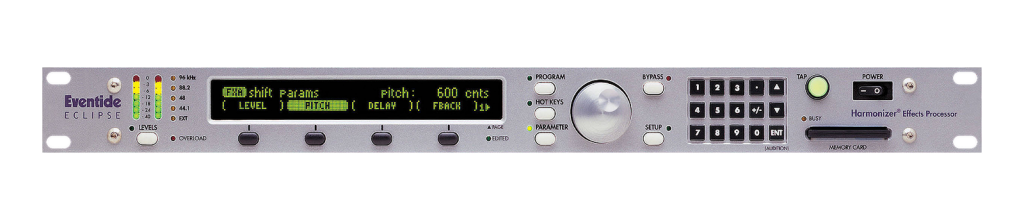
The Eclipse is Eventide's first single-rackspace Harmonizer, reviewed by Sound on Sound as far back as September 2001. The V4 firmware, released in 2009, folded in the entire TimeFactor and ModFactor stompbox algorithm catalog, taking the effects count from 90 to 113 and the preset count past 500, according to Audiofanzine's coverage of the update.
Eventide still lists Eclipse V4 on its own site, but several major dealers — including Vintage King and Music Matter — mark it "no longer available" or "discontinued" in new condition. That single fact changes the buying decision more than any spec sheet does.
Full Specification Comparison
| Spec | Eventide H90 Harmonizer | Eventide Eclipse V4 |
|---|---|---|
| Format | Floor pedal | 1U rackmount |
| Algorithms | 74 (52 legacy + 22 new) | ~100–113 with TimeFactor/ModFactor |
| Simultaneous effects | 2, series or parallel | 2 effects blocks, series/parallel/dual-mono |
| Bit depth / sample rate | Not published by Eventide as a marketing spec | 24-bit / up to 96kHz |
| Processing architecture | ARM-based (shared lineage with H9000) | Legacy dual-engine DSP |
| Analog I/O | 4x ¼" TS inputs/outputs, 2x expression/aux | Balanced XLR + unbalanced ¼" in/out |
| Digital I/O | USB-C only | AES/EBU, S/PDIF, ADAT Lightpipe, Word Clock |
| Control surface | 5 push knobs, 7 LED buttons, 3 footswitches, OLED display | Data wheel, 15-button keypad, VFD display |
| Preset storage | Internal + Eventide Control software | Internal + CompactFlash card slot |
| Built-in tuner | Yes | No |
| Weight | 1.85 lb / 0.84 kg | 9 lb / 4.1 kg |
| Power draw | 12V DC, 1A | 40W, 100–240VAC |
| MSRP / market status | $899, currently in production | Discontinued at most dealers; used units ~$1,200–$2,000+ |
Sources: Eventide H90 spec page, Eventide Eclipse V4 spec page, Gearspace user pricing discussion.
Where Each Unit Genuinely Wins
The H90 Wins On:
- Portability. It weighs under two pounds and fits a standard pedalboard, per Eventide's published dimensions.
- Modern pitch shifting. Its SIFT (Spectral Instantaneous Frequency Tracking) technology delivers polyphonic pitch shifts with far less warble than older loop-and-crossfade methods, according to Sound on Sound.
- Active development. Eventide keeps shipping free firmware updates, including a 2025 granular-effects expansion, per the current product page.
- Buying confidence. New unit, full warranty, in-stock dealers everywhere.
- Vocal tools. Harmonizer+ adds VocalTune, VocalShift, and Quadravox+, built from H9000 technology.
The Eclipse V4 Wins On:
- Digital connectivity. AES/EBU, S/PDIF, ADAT, and Word Clock let it slot directly into a professional studio's digital patchbay — the H90 has none of these.
- True dual-mono operation. Two fully independent stereo effects blocks with their own routing, ideal for tracking two sources at once.
- Reverb depth. Eleven reverb algorithms plus four "plex" algorithms, ported from Eventide's Orville and DSP7000 series, per Eventide's own Eclipse page.
- Broadcast-grade specs. Signal-to-noise ratio above 104dB on input and 108dB on output.
- Track record. Used by touring engineers on acts including Aerosmith and Lady Gaga, according to Eventide's artist gallery.
The Honest Trade-Offs
Here's the part most comparison articles gloss over: this isn't really an apples-to-apples fight. It's closer to comparing a Swiss Army knife to a table saw. Both cut. Only one fits in your pocket.
| Consideration | H90 | Eclipse V4 |
|---|---|---|
| Best environment | Live pedalboard, DAWless rig, small studio | Fixed studio rack, FOH rack, post-production suite |
| Learning curve | Moderate — front panel plus software editor | Steeper — the Tape Op review notes the H90 manual itself recommends real study time; Eclipse asks for more |
| Ongoing support | Active firmware updates as of 2025–2026 | Mature, stable, but not actively expanded |
| Resale/availability risk | Low — current production | High — buying used, no factory warranty |
| Signal path philosophy | Instrument-first, guitar/bass friendly | Line-level studio-first, with instrument-capable jacks |
What Reviewers Get Wrong (Or Skip)
A lot of gear coverage treats "algorithm count" as the whole story. It isn't. Two units can both claim "100 effects" while feeling completely different in a mix.
- Algorithm count isn't sound quality. The Eclipse's reverbs come from Eventide's flagship Orville processor lineage. The H90's newer algorithms are optimized for pedalboard latency and real-time footswitch control. Different goals, not a simple "more is better" race.
- The Eclipse's biggest cost isn't the unit — it's the rig around it. You need a rack, a power conditioner, and often a MIDI controller to unlock its full expression. Reviews rarely add that up.
- "Discontinued" doesn't mean "obsolete." Eventide still supports Eclipse firmware downloads, and studios still track it in daily use. It means new-unit buying is basically over.
So, Which One Actually Deserves Your Money?
- Gigging guitarist or bassist: H90. It's built for your board, your feet, and your signal chain.
- Home or project studio owner building a first serious effects rack: H90, run through an audio interface's send/return, still covers most needs at a fraction of the space and cost.
- Professional studio or FOH engineer with an existing digital rack: Eclipse V4, if you can find a clean used unit and your patchbay already speaks AES/EBU or ADAT.
- Vocal production specialist: H90's Harmonizer+ suite is newer and purpose-built for this; check current pricing at Eventide's official H90 page.
- Collector or vintage-tone chaser: Eclipse V4, for the Orville-derived reverbs alone — but budget for used-market pricing and zero warranty.
Frequently Asked Questions
Is the Eventide H90 a replacement for the Eclipse?
Not directly. The H90 replaces the H9 pedal line. The Eclipse sits in Eventide's rackmount category, and Eventide has not announced a direct rack successor with the same digital I/O set.
Can the H90 do everything the Eclipse can do?
No. The H90 lacks AES/EBU, S/PDIF, ADAT, and Word Clock connections entirely. If your studio routes audio digitally between racks, the Eclipse still fills a gap the H90 doesn't address.
Is it worth buying a used Eclipse V4 in 2026?
It depends on your setup. If you need dual-mono digital processing at 24-bit/96kHz and already have rack space and a patchbay, yes. If you just want great reverb and pitch-shifting for guitar, the H90 gets you there for less money and zero used-gear risk.
Does the H90 have a tuner and does the Eclipse?
The H90 has a built-in tuner, confirmed on Eventide's official spec sheet. The Eclipse's published specifications do not list a tuner function.
Which one is easier to learn?
Guitarists generally find the H90 faster to learn, since it's designed around footswitch workflows and a free editor app. The Eclipse rewards patience — its keypad-and-wheel interface predates modern touch workflows, per Premier Guitar's hands-on review.
Final Word
The H90 and Eclipse V4 aren't really rivals. They're two answers to two different questions. The H90 asks: "What's the best Harmonizer I can strap to my pedalboard today?" The Eclipse asks: "What's the best Harmonizer I can bolt into a professional rack?"
Pick based on where the unit will physically live and what it needs to plug into — not just the algorithm count on the spec sheet. That single decision will tell you which name deserves your money.
Sources
- Eventide — H90 Harmonizer official specifications
- Eventide — Eclipse V4 official specifications
- Sound on Sound — Eventide H90 Harmonizer review
- Sound on Sound — Eventide Eclipse V4 review
- Premier Guitar — Eventide Eclipse V4 Effects Unit review
- Tape Op — Eventide H90 Harmonizer review
- MMR Magazine — H90 Harmonizer launch announcement
- Audiofanzine — Eclipse V4 software release notes
- Vintage King — Eclipse V4 used listing and availability status
A spec-by-spec, no-fluff comparison for guitarists, vocal engineers, and studio owners deciding between two very different Eventide Harmonizers.
Quick answer: Buy the H90 if you want a current-production, pedalboard-sized Harmonizer with 74 algorithms and a $899 price tag. Buy the Eclipse V4 only if you already run a rack-based studio or live rig and specifically need its 24-bit/96kHz dual-mono processing and deep digital I/O — and only if you can find a used unit, since Eventide's retail partners currently list it as discontinued or out of stock.
Why This Comparison Is Harder Than It Looks
Most "vs" articles compare two products from the same year. This one doesn't. The H90 is a 2022 pedal built for the pedalboard. The Eclipse V4 is a 1U rack processor whose software platform dates back to 2001, updated to Version 4 in 2009, according to Mix Online's coverage of the V4 release.
They share a name, a company, and a lot of DNA. They do not share a form factor, a price bracket, or a target buyer. That's the part most gear sites skip.
What You'll Actually Learn Here
- The hard specs, side by side, pulled from Eventide's own product pages
- Which unit fits a guitar pedalboard versus a studio rack
- Real current pricing, including the used-market reality for the Eclipse
- Who regrets buying which one, based on published reviews
Meet the Contenders
Eventide H90 Harmonizer
The H90 launched in November 2022 as the successor to the popular H9. It runs on ARM-based processing borrowed from Eventide's flagship H9000 rack unit, according to Sound on Sound's review. That upgrade lets it run true polyphonic pitch shifting without the warble older pitch-shift algorithms are known for.
It ships with 74 algorithms today: the original 52 from the H9 Max, plus 22 newer additions covering granular textures and vocal processing, per Eventide's current H90 specification page.
Eventide Eclipse V4
The Eclipse is Eventide's first single-rackspace Harmonizer, reviewed by Sound on Sound as far back as September 2001. The V4 firmware, released in 2009, folded in the entire TimeFactor and ModFactor stompbox algorithm catalog, taking the effects count from 90 to 113 and the preset count past 500, according to Audiofanzine's coverage of the update.
Eventide still lists Eclipse V4 on its own site, but several major dealers — including Vintage King and Music Matter — mark it "no longer available" or "discontinued" in new condition. That single fact changes the buying decision more than any spec sheet does.
Full Specification Comparison
| Spec | Eventide H90 Harmonizer | Eventide Eclipse V4 |
|---|---|---|
| Format | Floor pedal | 1U rackmount |
| Algorithms | 74 (52 legacy + 22 new) | ~100–113 with TimeFactor/ModFactor |
| Simultaneous effects | 2, series or parallel | 2 effects blocks, series/parallel/dual-mono |
| Bit depth / sample rate | Not published by Eventide as a marketing spec | 24-bit / up to 96kHz |
| Processing architecture | ARM-based (shared lineage with H9000) | Legacy dual-engine DSP |
| Analog I/O | 4x ¼" TS inputs/outputs, 2x expression/aux | Balanced XLR + unbalanced ¼" in/out |
| Digital I/O | USB-C only | AES/EBU, S/PDIF, ADAT Lightpipe, Word Clock |
| Control surface | 5 push knobs, 7 LED buttons, 3 footswitches, OLED display | Data wheel, 15-button keypad, VFD display |
| Preset storage | Internal + Eventide Control software | Internal + CompactFlash card slot |
| Built-in tuner | Yes | No |
| Weight | 1.85 lb / 0.84 kg | 9 lb / 4.1 kg |
| Power draw | 12V DC, 1A | 40W, 100–240VAC |
| MSRP / market status | $899, currently in production | Discontinued at most dealers; used units ~$1,200–$2,000+ |
Sources: Eventide H90 spec page, Eventide Eclipse V4 spec page, Gearspace user pricing discussion.
Where Each Unit Genuinely Wins
The H90 Wins On:
- Portability. It weighs under two pounds and fits a standard pedalboard, per Eventide's published dimensions.
- Modern pitch shifting. Its SIFT (Spectral Instantaneous Frequency Tracking) technology delivers polyphonic pitch shifts with far less warble than older loop-and-crossfade methods, according to Sound on Sound.
- Active development. Eventide keeps shipping free firmware updates, including a 2025 granular-effects expansion, per the current product page.
- Buying confidence. New unit, full warranty, in-stock dealers everywhere.
- Vocal tools. Harmonizer+ adds VocalTune, VocalShift, and Quadravox+, built from H9000 technology.
The Eclipse V4 Wins On:
- Digital connectivity. AES/EBU, S/PDIF, ADAT, and Word Clock let it slot directly into a professional studio's digital patchbay — the H90 has none of these.
- True dual-mono operation. Two fully independent stereo effects blocks with their own routing, ideal for tracking two sources at once.
- Reverb depth. Eleven reverb algorithms plus four "plex" algorithms, ported from Eventide's Orville and DSP7000 series, per Eventide's own Eclipse page.
- Broadcast-grade specs. Signal-to-noise ratio above 104dB on input and 108dB on output.
- Track record. Used by touring engineers on acts including Aerosmith and Lady Gaga, according to Eventide's artist gallery.
The Honest Trade-Offs
Here's the part most comparison articles gloss over: this isn't really an apples-to-apples fight. It's closer to comparing a Swiss Army knife to a table saw. Both cut. Only one fits in your pocket.
| Consideration | H90 | Eclipse V4 |
|---|---|---|
| Best environment | Live pedalboard, DAWless rig, small studio | Fixed studio rack, FOH rack, post-production suite |
| Learning curve | Moderate — front panel plus software editor | Steeper — the Tape Op review notes the H90 manual itself recommends real study time; Eclipse asks for more |
| Ongoing support | Active firmware updates as of 2025–2026 | Mature, stable, but not actively expanded |
| Resale/availability risk | Low — current production | High — buying used, no factory warranty |
| Signal path philosophy | Instrument-first, guitar/bass friendly | Line-level studio-first, with instrument-capable jacks |
What Reviewers Get Wrong (Or Skip)
A lot of gear coverage treats "algorithm count" as the whole story. It isn't. Two units can both claim "100 effects" while feeling completely different in a mix.
- Algorithm count isn't sound quality. The Eclipse's reverbs come from Eventide's flagship Orville processor lineage. The H90's newer algorithms are optimized for pedalboard latency and real-time footswitch control. Different goals, not a simple "more is better" race.
- The Eclipse's biggest cost isn't the unit — it's the rig around it. You need a rack, a power conditioner, and often a MIDI controller to unlock its full expression. Reviews rarely add that up.
- "Discontinued" doesn't mean "obsolete." Eventide still supports Eclipse firmware downloads, and studios still track it in daily use. It means new-unit buying is basically over.
So, Which One Actually Deserves Your Money?
- Gigging guitarist or bassist: H90. It's built for your board, your feet, and your signal chain.
- Home or project studio owner building a first serious effects rack: H90, run through an audio interface's send/return, still covers most needs at a fraction of the space and cost.
- Professional studio or FOH engineer with an existing digital rack: Eclipse V4, if you can find a clean used unit and your patchbay already speaks AES/EBU or ADAT.
- Vocal production specialist: H90's Harmonizer+ suite is newer and purpose-built for this; check current pricing at Eventide's official H90 page.
- Collector or vintage-tone chaser: Eclipse V4, for the Orville-derived reverbs alone — but budget for used-market pricing and zero warranty.
Frequently Asked Questions
Is the Eventide H90 a replacement for the Eclipse?
Not directly. The H90 replaces the H9 pedal line. The Eclipse sits in Eventide's rackmount category, and Eventide has not announced a direct rack successor with the same digital I/O set.
Can the H90 do everything the Eclipse can do?
No. The H90 lacks AES/EBU, S/PDIF, ADAT, and Word Clock connections entirely. If your studio routes audio digitally between racks, the Eclipse still fills a gap the H90 doesn't address.
Is it worth buying a used Eclipse V4 in 2026?
It depends on your setup. If you need dual-mono digital processing at 24-bit/96kHz and already have rack space and a patchbay, yes. If you just want great reverb and pitch-shifting for guitar, the H90 gets you there for less money and zero used-gear risk.
Does the H90 have a tuner and does the Eclipse?
The H90 has a built-in tuner, confirmed on Eventide's official spec sheet. The Eclipse's published specifications do not list a tuner function.
Which one is easier to learn?
Guitarists generally find the H90 faster to learn, since it's designed around footswitch workflows and a free editor app. The Eclipse rewards patience — its keypad-and-wheel interface predates modern touch workflows, per Premier Guitar's hands-on review.
Final Word
The H90 and Eclipse V4 aren't really rivals. They're two answers to two different questions. The H90 asks: "What's the best Harmonizer I can strap to my pedalboard today?" The Eclipse asks: "What's the best Harmonizer I can bolt into a professional rack?"
Pick based on where the unit will physically live and what it needs to plug into — not just the algorithm count on the spec sheet. That single decision will tell you which name deserves your money.
Sources
- Eventide — H90 Harmonizer official specifications
- Eventide — Eclipse V4 official specifications
- Sound on Sound — Eventide H90 Harmonizer review
- Sound on Sound — Eventide Eclipse V4 review
- Premier Guitar — Eventide Eclipse V4 Effects Unit review
- Tape Op — Eventide H90 Harmonizer review
- MMR Magazine — H90 Harmonizer launch announcement
- Audiofanzine — Eclipse V4 software release notes
- Vintage King — Eclipse V4 used listing and availability status
