
Finding out that a range hood insert does not fit your cabinet can be frustrating, especially after you have already bought the appliance or prepared the installation area. However, a poor fit does not always mean the product is defective. The problem may involve the cabinet opening, appliance dimensions, installation clearances, mounting points, ductwork, or internal obstructions. It is also common to confuse an insert's overall dimensions with its required cutout dimensions.
The safest approach is not to force the unit into place or immediately start cutting the cabinet. Instead, measure the usable opening, compare those measurements with the manufacturer's installation specifications, identify the source of the mismatch, and then decide whether modification, exchange, or replacement makes the most sense.
Quick Answer: Why Doesn't a Range Hood Insert Fit?
A range hood insert may not fit because the cabinet opening is too narrow, too shallow, or too low for the appliance. Shelves, framing, wiring, or ductwork can also reduce the usable space. Another common cause is relying on the product's advertised width instead of checking its required cutout dimensions and clearances.
Before changing the cabinet, take accurate measurements and compare them with the manufacturer's installation instructions. The goal is not simply to make the appliance physically enter the cabinet; it must also have the required space for mounting, ventilation, ducting, and other installation components.
Don't Force an Insert Into a Tight Opening
If an insert is difficult to push into the cabinet, stop rather than forcing it. Pressure can damage cabinet edges, trim, mounting points, or the appliance itself. A unit that squeezes into an opening may still be impossible to secure correctly or may not meet the manufacturer's clearance requirements.
Understand Overall, Cutout, and Clearance Dimensions
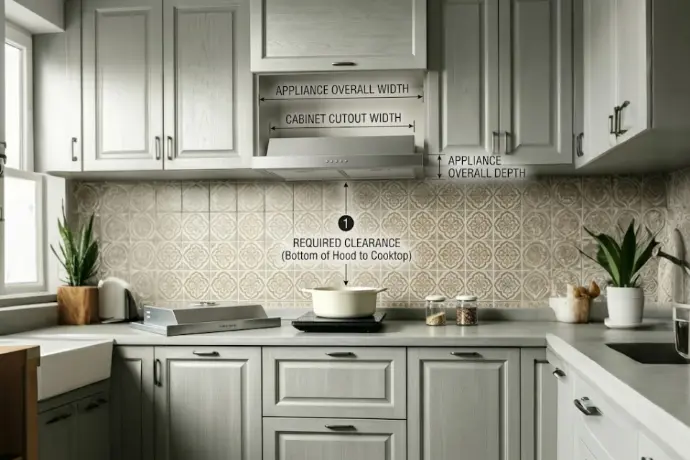
One of the most important steps is understanding that three different measurements can matter. Overall dimensions describe the physical size of the appliance. Cutout dimensions describe the opening needed to install it. Clearance requirements describe the space that must remain around the appliance or its components.
These measurements are related but are not necessarily identical. An appliance described as 30 inches wide, for example, does not automatically require a 30-inch opening. The manufacturer may specify a different cutout width, along with particular depth, height, mounting, and clearance requirements.
|
Dimension |
What it means |
Why it matters |
|
Overall width |
Physical width of the appliance |
Determines available cabinet space |
|
Cutout width |
Required cabinet opening |
Determines whether installation is possible |
|
Overall depth |
Front-to-back appliance size |
Checks cabinet depth |
|
Cutout height |
Required vertical opening |
Confirms available height |
|
Clearance |
Required surrounding space |
Helps maintain proper installation conditions |
Always use the installation documentation for the specific model rather than assuming dimensions are interchangeable between products.
How to Measure Your Cabinet Opening Correctly
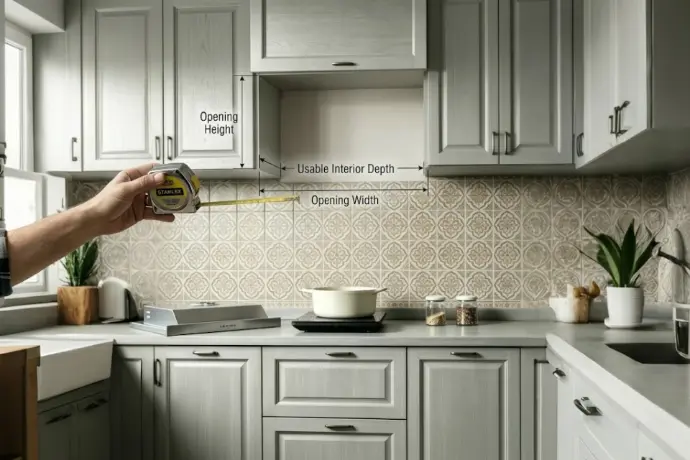
Measure the actual usable opening instead of relying only on the cabinet's exterior dimensions. Use a tape measure and record the measurements carefully. If the opening is irregular, measure at more than one point because cabinet construction may create slight variations.
Start with the opening width, then measure its height and usable interior depth. Check the side and rear areas for framing, shelves, braces, wiring, duct connections, or other components that may reduce available space. Also note where the duct and electrical connections are located.
When comparing models, use the cabinet measurements alongside the manufacturer's specifications for the range hood insert. Do not compare only the advertised product width. The required cutout, mounting method, depth, and clearances can determine whether an appliance is actually compatible.
5 Common Reasons a Range Hood Insert Doesn't Fit
The Cabinet Opening Is Too Narrow
A narrow opening is one of the simplest causes of a fit problem. Cabinet trim and framing can reduce the opening compared with its nominal size. Measure the actual opening and compare it with the specified cutout width.
The Cabinet Isn't Deep Enough
Depth is easy to overlook because range hood products are often discussed by width. However, the appliance needs enough front-to-back space to sit correctly and accommodate its installation components. Measure the usable depth from the mounting area to any obstruction, rather than assuming the cabinet's outside depth is fully available.
The Insert Is Too Tall
Vertical space can be limited by a cabinet shelf, framing member, or the construction of the opening. Compare the required cutout height with the available height before removing anything. Also check whether the installation requires additional space above or around the unit.
Something Inside the Cabinet Is Blocking It
A shelf, divider, support rail, duct, junction box, or wiring can make an otherwise suitable opening unusable. Identify exactly what is causing the interference before considering modification. Moving one obstruction may be very different from removing a structural component.
The Wrong Dimensions Were Used
Retail listings and product titles may emphasize a nominal width, but installation depends on the manufacturer's detailed specifications. Always verify the installation manual or official product documentation before cutting or modifying cabinetry.
Can You Modify the Cabinet to Make It Fit?
Sometimes a cabinet can be modified, but whether it should be depends on how the cabinet is built and what needs to change. Removing a small nonstructural obstruction may be different from cutting a cabinet frame or support that contributes to stability.
Before modifying anything, determine exactly how much material would need to be removed and whether the finished installation would still meet the appliance's requirements. Major changes can affect appearance, strength, duct routing, or electrical configuration.
Do not treat cabinet modification as a guaranteed solution. If structural parts, wiring, or major ductwork are involved, consult an appropriately qualified professional. The objective is not merely to create a larger hole; it is to create an installation that remains secure and meets the manufacturer's instructions.
What If the Cabinet Opening Is Larger Than the Insert?
A cabinet opening larger than the insert can leave visible gaps or create mounting and finishing problems. It may also affect ventilation coverage.
Do not assume that any gap can simply be filled or that improvised brackets are acceptable. Check the manufacturer's installation requirements first. Depending on the mismatch and cabinet design, a compatible insert, appropriate trim solution, or different installation approach may be preferable.
Check Ducting, Mounting, and Electrical Requirements
Physical fit is only one part of compatibility. An insert can fit inside the cabinet and still be unsuitable if its duct connection cannot reach the existing duct route or if the required mounting arrangement cannot be achieved.
Check the duct location, duct size, route, and connection requirements before installation. At the same time, review mounting points and any support requirements specified by the manufacturer.
Electrical requirements also deserve attention. Check the specified connection method and location, and do not move or alter wiring simply to make the appliance fit. Follow the installation instructions and use qualified assistance when electrical work or substantial modifications are needed.
How to Choose a Replacement Insert That Will Fit
If the original appliance is incompatible, start with the cabinet rather than shopping by appliance width alone. Record the opening width, opening height, usable depth, side and rear clearances, duct location, and electrical requirements. Then compare those measurements with the complete installation specifications of potential replacements.
When comparing models from manufacturers such as Ciarra Gadgets, look beyond the headline width and review the published installation dimensions, cutout requirements, mounting instructions, duct configuration, and required clearances. This reduces the chance of choosing another appliance that looks suitable but creates problems during installation.
Before You Buy: Range Hood Insert Fit Checklist
Before ordering a replacement, verify:
● Cabinet opening width
● Cabinet opening height
● Usable interior depth
● Side and rear clearance
● Internal obstructions
● Duct location and configuration
● Electrical requirements
● Mounting requirements
● Manufacturer's cutout dimensions
● Required installation clearances
Record the actual usable dimensions and compare them directly against the installation diagram for the exact model you plan to purchase.
When Should You Stop Modifying and Replace the Insert?
Replacement or exchange may be the better choice when the dimensional mismatch is substantial, structural cabinet components would need to be removed, required clearances cannot be maintained, or the existing duct and electrical arrangement cannot accommodate the appliance.
A product that requires extensive alteration may create more work and uncertainty than choosing a compatible model. If the appliance is new and return or exchange options are available, compare that option with the cost and complexity of modifying the cabinet.
Conclusion
When a range hood insert does not fit a cabinet, the best solution is to diagnose the mismatch before making changes. Measure the actual opening, distinguish overall dimensions from cutout requirements, check for internal obstructions, and review ducting, mounting, electrical, and clearance specifications.
If a minor, appropriate adjustment can solve the problem without compromising the cabinet or installation requirements, modification may be possible. Otherwise, exchanging the appliance for a compatible model is often the simpler path. Before choosing another insert, verify the complete installation specifications rather than relying on the advertised width alone.
For homeowners comparing kitchen ventilation options, Ciarra Gadgets provides product information that can be reviewed alongside cabinet measurements and installation requirements. Always confirm the specifications for the exact model before purchasing.
Frequently Asked Questions
1. Why doesn't my range hood insert fit my cabinet?
A range hood insert may not fit because the cabinet opening is too narrow, shallow, or short. Internal shelves, framing, ductwork, wiring, or incorrect measurements can also cause installation problems.
2. How do I measure a cabinet for a range hood insert?
Measure the usable opening width, height, and interior depth, then check the available side and rear clearance. Compare these measurements with the manufacturer's required cutout dimensions and installation specifications.
3. Are range hood width and cutout width the same?
Not necessarily. The advertised width usually describes the appliance's overall size, while the cutout width specifies the opening required for installation. Always use the manufacturer's dimensions for the specific model.
4. Can I modify my cabinet to fit a range hood insert?
Some cabinets can be modified, but the suitability depends on their construction and what needs to be removed. Major changes involving structural components, electrical wiring, or ductwork may require qualified professional assistance.
5. What should I do if my range hood insert fits but the ductwork doesn't?
Check the manufacturer's ducting requirements and compare them with the existing duct size, location, and route. A physically compatible insert may still require a different duct configuration before it can be properly installed.
