
https://edwardsrestore.com/roofing/If you live in a Victorian or Edwardian terrace, there is a good chance you walk past some of your most valuable space every day without noticing it. The narrow alley running down the side of the house, often used for nothing more than bins and the odd bike, is prime territory for a side return extension. Fill it in well and a cramped, dark kitchen becomes a bright, open-plan room.
It is a popular project for good reason, and the experts agree on where the value lies. "A side return is some of the most underused space in a house," says a spokesperson for Heritage Build Group, a Kettering firm that builds home extensions and fits kitchens. "Done well, it floods the kitchen with light and turns a cramped galley into a proper open-plan room the whole family actually uses." This guide walks through what a side return extension is, why it works, the design ideas worth considering, and what to plan for before you start.
What is a side return extension?
A side return is the strip of outdoor space that runs alongside the back portion of a terraced or semi-detached house, beside the original rear projection known as the outrigger. It was historically left open to let light into the back room, and today it usually sits unused.
A side return extension fills in that strip, widening the rear of the house. Because the kitchen is typically at the back, the result is almost always a bigger, brighter, more usable kitchen and dining space without losing much, if any, garden.
Why a side return extension works so well
The appeal comes down to a handful of clear benefits:
- * It reclaims dead space. You are building on land you already own but cannot currently use.
- * It floods the kitchen with light. Roof glazing over the new section brings daylight deep into rooms that were previously gloomy. However, altering your roofline to accommodate these glass features requires meticulous structural execution where the old and new materials meet. Homeowners dealing with severe seasonal weather, much like families seeking dependable Roof Repair St. Louis services, know that flawless flashing at these critical structural junctions is vital to prevent hidden leaks.
- It creates open-plan family space. Knocking the side return into the kitchen opens up room for a island, a dining table and a sociable layout.
- It keeps most of your garden. Unlike a deep rear extension, a side return mainly uses space at the side, so the lawn stays largely intact.
- It can add value. In sought-after areas especially, the quality of space a side return creates can offer a strong return, though the main reward is how the room feels to live in.
Side return extension ideas to consider
This is where the project comes to life. Some of the most effective side return extension ideas focus on light and flow:
- Roof lanterns and skylights. A run of rooflights along the new roof is the single best way to pour daylight into the space and the rooms beyond it.
- Glazing and doors to the garden. Bifold, sliding or slim Crittall-style doors at the rear connect the kitchen to the outside and make the whole room feel larger.
- A kitchen island. With the extra width, an island works as a prep area, a breakfast bar and a natural divide between cooking and dining.
- Broken-plan zoning. Use a half wall, a change in flooring or the island itself to give the cooking, eating and relaxing areas their own distinct feel without closing anything off.
- Continuous flooring. Running the same floor from inside out through to the patio blurs the threshold and stretches the sense of space.
- A built-in banquette. Bench seating tucked along a wall seats more people in less room and adds handy hidden storage.
- An internal courtyard. On longer plots, leaving a small glazed courtyard keeps light flowing into the original middle room.
Types and layouts
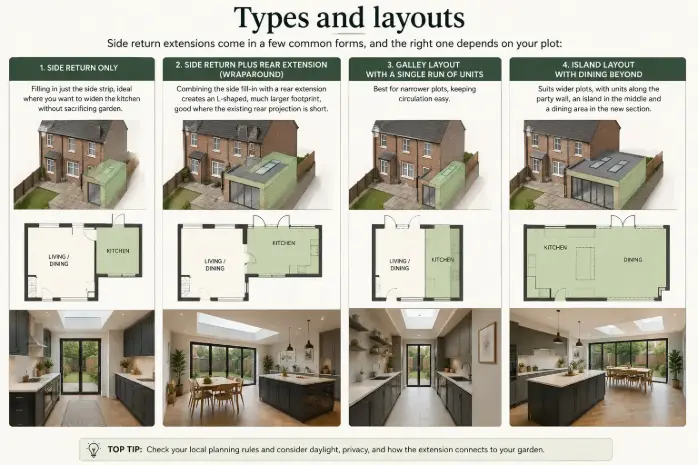
Side return extensions come in a few common forms, and the right one depends on your plot:
- Side return only. Filling in just the side strip, ideal where you want to widen the kitchen without sacrificing garden.
- Side return plus rear extension (wraparound). Combining the side fill-in with a rear extension creates an L-shaped, much larger footprint, good where the existing rear projection is short.
- Galley layout with a single run of units. Best for narrower plots, keeping circulation easy.
- Island layout with dining beyond. Suits wider plots, with units along the party wall, an island in the middle and a dining area in the new section.
Whether you want a compact, light-filled kitchen or a full open-plan hub, there is a configuration to match the space you have.
What to plan for
A side return is a rewarding project, but it is a tricky build in a tight space, so plan properly:
- Planning permission. Many side returns fall under permitted development, often allowing a rear projection of around three metres on a terrace or semi, with larger rights available subject to prior approval. Listed buildings and conservation areas have stricter rules, so always check with your local council first.
- Party wall agreement. Because you are building close to a boundary, you will usually need a party wall agreement with your neighbours. Start that conversation early, ideally a couple of months ahead.
- Drainage. There is often a manhole or shared drain in the side return. Working out a drainage strategy early can have a big effect on the design, so it needs sorting at the start, not the end.
- Structure. Opening up the side wall means inserting a steel beam, and larger openings may need a goal-post or box frame. A structural engineer is essential here.
- Light to the middle room. Filling in the side return reduces light to the original back room, so plan rooflights or a courtyard to keep it bright.
- Budget. Side returns cost more per square metre than many extensions because of the fiddly groundworks and structural work in a confined space, so build in a sensible contingency.
Final thoughts
A side return extension is one of the smartest ways to get more from a terraced or semi-detached home, turning forgotten space down the side of the house into the brightest, most sociable room you have. Focus on light and flow first, choose a layout that suits how your family lives, and get the planning, party wall and structural details nailed down early. Do that, and a narrow strip you barely noticed becomes the part of the house you never want to leave.
