
A leak is supposed to be obvious. That assumption drives most homeowner plumbing decisions, and on a slab foundation it is quietly wrong. When a water bill doubles with no puddle in sight, leak detection Nashville TN has to begin below the surface, not with a visual search. The most expensive leaks never break through a wall or a ceiling at all, and the ones that do the real damage can run for months while the house above them looks completely normal.
Most Costly Leaks Never Reach The Surface
Under a slab foundation, water escaping a pipe soaks straight into gravel and soil, nowhere near the drywall where a homeowner would actually notice it. A pinhole in a copper line can push out gallons an hour into the ground, and none of it ever drips through a ceiling. On an older brick ranch in East Nashville, the case we see most often is a slab leak that surfaces as nothing but a climbing bill and a faint warm patch on one stretch of floor. The stakes on that wasted water keep rising, and the Alliance for Water Efficiency reported in December 2025 that Texas voters had authorized $20 billion for water projects through Proposition 4, the largest state water-supply investment in 180 years. Every gallon lost underground is now a gallon that utilities are spending record sums to replace.
Rising Bills Reveal What Eyes Cannot
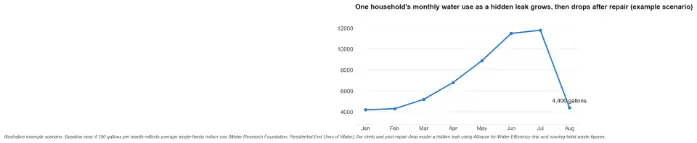
The bill is where a buried leak finally turns visible, because the meter doesn't lie even when every wall in the house stays dry. A household on that same East Nashville ranch might run near 4,100 gallons in a normal month, then watch the number climb with nothing in the house to explain it. Nashville's Metro Water Services lets account holders pull their own hourly usage online, and a flat overnight line that never dips toward zero is the fingerprint of water moving while nobody is home.
Some home systems tell you exactly when to act. NC State Extension advises pumping a septic tank once sludge reaches 25 to 33 percent of its liquid capacity or scum tops 4 to 6 inches, a clear numeric trigger a homeowner can plan around. A pressurized water line gives no such threshold, so the bill and the meter end up being the only early evidence a hidden leak ever hands over.
Acoustic Sensors Find Leaks Without Demolition
Non-invasive detection earns its name at exactly this point in the job. Instead of opening walls to find the leak, technicians listen for it and let the equipment do the pointing. Acoustic sensors pick up the specific high-frequency hiss that pressurized water makes as it forces through a pinhole or a cracked joint, a sound the human ear cannot pull apart from ordinary household noise. Correlators placed at two points on the same line measure the tiny delay between when each sensor hears that hiss, then calculate the leak's position to within a foot or two. Thermal imaging adds a second reading, mapping the temperature difference where hot or cold water spreads under a floor or behind plaster. On a slab, those two methods together can narrow a leak to a single tile before anyone picks up a hammer. The best crews run both passes even when the first one looks conclusive. A slab can hide a second leak a few feet from the first, and finding only one means returning to tear up the floor a second time. Jackhammering a foundation on a guess is the exact outcome that careful detection exists to prevent.
The reason for all this instrumentation is narrow and worth saying plainly. Finding the leak precisely is what keeps the repair small. A pinpointed slab leak often means cutting one neat access hole instead of trenching a whole room, and that difference lands directly on the final invoice.
Guesswork is the expensive part, not the repair itself. Pinpoint the leak and the fix is almost anticlimactic.
Early Detection Beats Waiting For Damage
Waiting for a hidden leak to reveal itself puts the foundation itself at risk. Left alone, a slab leak keeps working at the soil under the footing, and what starts as a $60 spike on the bill can turn into a cracked slab, warped flooring, and mold that costs thousands to remediate. The arithmetic almost always favors moving early, while the problem is still just water and a meter reading.
The myth that a leak will always show itself in time is the belief that costs homeowners the most. Scheduling leak detection Nashville TN residents can rely on at the first unexplained jump in usage is what keeps a small underground problem from becoming a structural one. A buried pipe sends no warning on its own, which leaves the meter reading and an early professional inspection as the only signals a homeowner actually gets.
