
It can be frustrating to remove a tray from the oven and find one side golden brown while the other side is still pale or undercooked. This can happen even when you follow the same recipe and cooking time carefully. A countertop oven does not always distribute heat perfectly evenly throughout its compact cooking chamber. The position of heating elements, airflow, rack placement, cookware, and temperature accuracy can all affect the result.
The good news is that uneven cooking does not automatically mean the appliance is defective. By looking for repeatable patterns and changing one factor at a time, you can often improve cooking consistency and identify whether the issue is simply normal heat variation or something that needs further attention.
Quick Answer
One side can cook faster because different areas inside an oven may receive different amounts of radiant heat and circulating air. Food placed closer to a heating element may brown sooner, while a crowded pan or unusual airflow pattern can affect another area. Rack position, cookware, preheating, and temperature accuracy also matter. Minor differences are common, but a sudden or extreme change deserves investigation.
Why Does a Countertop Oven Cook One Side Faster Than the Other?
The simplest explanation is that heat does not reach every part of the cooking chamber in the same way. Heating elements produce radiant heat, while convection systems move heated air around the interior. The balance between those two heat-transfer methods depends on the oven's design, cooking mode, fan position, and the location of the food.
A compact cooking chamber can make these differences more noticeable because food sits relatively close to the heating elements and interior walls. A tray placed slightly toward one side may therefore experience a different combination of radiant heat and airflow than a centered tray. The food itself can also influence the result.
Minor differences in browning are not automatically a sign of a faulty appliance. The more useful question is whether the same area repeatedly cooks faster. If the same corner of a tray becomes darker across several similar cooking sessions, the pattern is worth investigating because it suggests the cooking environment is contributing to the result.
How Uneven Heat Distribution Creates Hot Spots
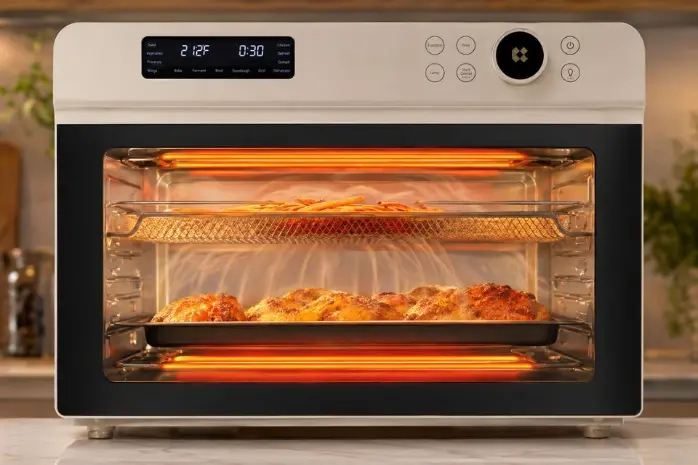
A hot spot is an area that consistently exposes food to more effective heat than nearby areas. It can develop because of heating-element placement, airflow, reflections from interior surfaces, or the distance between the food and the heat source. In a small appliance, even a modest difference in position can change how quickly the surface of food browns.
For example, imagine baking a tray of cookies with identical dough portions. If the cookies near one side repeatedly become darker before the others, the difference may reflect the oven's heat pattern rather than the recipe. The same observation becomes more convincing if it appears again after another preheated cooking cycle.
Radiant heat is particularly important near exposed heating elements. Food closer to an active element can receive stronger direct heat, while other areas depend more on circulating air. Convection can reduce some temperature differences, but it cannot guarantee that every location will behave identically.
Another useful clue is whether the problem affects only the surface color or the actual doneness of the food. If both sides reach the expected internal doneness but one side is darker, the difference may mainly concern browning. If one side remains noticeably undercooked, temperature, food thickness, placement, or airflow deserves closer attention. This distinction prevents you from treating every color difference as evidence of an appliance fault. That simple distinction can prevent unnecessary adjustments and help you decide when further testing is worthwhile.
Can Rack Position and Pan Placement Cause Uneven Cooking?
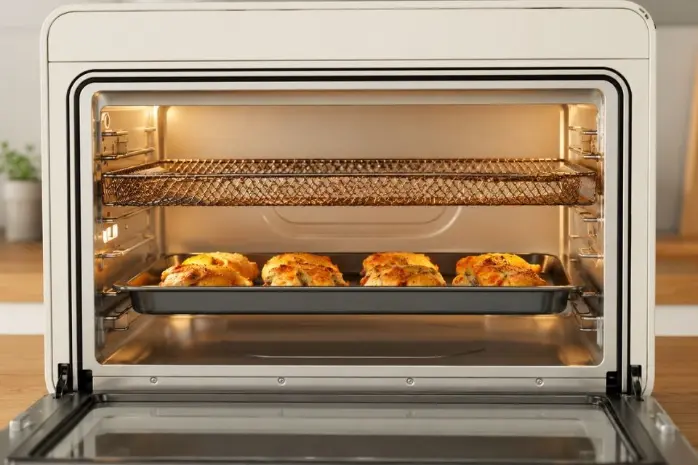
Yes. Rack position changes the distance between the food and the heating elements, which can affect surface browning and cooking speed. The best rack position can vary by cooking mode, recipe, and oven design, so following the appliance's instructions is usually the safest starting point.
Pan placement matters just as much. If a tray is pushed toward a side wall, one edge may be closer to a heating element or exposed to a different airflow pattern. Centering the cookware when appropriate can reduce unnecessary differences and make results easier to reproduce.
A few practical adjustments can help:
● Use the rack position recommended for the cooking mode.
● Keep the pan reasonably centered unless instructions say otherwise.
● Avoid placing food unnecessarily close to a heating element.
● Rotate the tray when the recipe and food type allow it.
Rotating a tray halfway through cooking can improve browning when one side consistently cooks faster. However, rotation should be considered a useful adjustment rather than a substitute for correct rack and pan placement.
How Convection Airflow Affects Browning
Convection cooking uses a fan to circulate heated air through the chamber. Moving air can improve heat transfer and may help food cook more efficiently, but airflow is not necessarily identical in every location. Fan position, chamber shape, cookware size, and the amount of food can all change how air moves.
Cookware can also interrupt airflow. A large pan may block circulation around its sides, while an overfilled tray can create its own sheltered areas. If your oven has a convection setting, avoid assuming that the fan is automatically the cause of uneven cooking. Instead, compare results with different food spacing and positions while keeping other conditions consistent.
Can Your Bakeware Make One Side Cook Faster?
The cookware itself can influence how heat reaches food. Different materials absorb, retain, and transfer heat at different rates. This is especially noticeable when using a countertop oven, where the cooking chamber is smaller, and the food may sit relatively close to the heating elements.
Size and shape matter as well. Oversized cookware can restrict airflow or place food unusually close to the chamber walls. A very small pan may leave more open space around the food and change how heated air reaches it. Neither situation is automatically wrong, but the difference can affect cooking behavior.
Always use cookware that is suitable for the appliance and appropriate for the cooking method.
Why Preheating and Temperature Accuracy Matter
Proper preheating gives the cooking chamber time to reach the intended operating temperature. Putting food into an oven before it has fully heated can change browning, texture, and cooking time, particularly for foods that depend on a stable temperature from the beginning.
The temperature displayed by an appliance also does not mean every point inside the chamber is always at exactly that temperature. Heating systems cycle, temperatures naturally fluctuate, and different areas can experience different conditions. Opening the door repeatedly can make the situation less stable by allowing heated air to escape.
How to Fix Uneven Cooking in a Countertop Oven
Start with simple adjustments and change one factor at a time. If you move the rack, change the cookware, lower the temperature, and rotate the tray all at once, you may improve the result without knowing which change made the difference. A systematic approach is more useful.
- Preheat properly. Give the oven enough time to reach the intended cooking temperature before adding food.
- Check the rack position. Use the position recommended for the recipe or cooking mode.
- Center the cookware. Avoid unnecessary off-center placement when the instructions do not specify otherwise.
- Avoid overcrowding. Leave enough space for heat and air to circulate around the food.
- Rotate when appropriate. If one side browns first, turn the tray partway through cooking when it is safe and suitable for the food.
- Check the cookware. Make sure the pan's size, material, and shape suit the appliance.
- Check the temperature. If heating seems inaccurate, compare the display with an independent oven thermometer.
- Watch for patterns. Repeated differences are more useful for diagnosis than one uneven batch.
How to Test Your Countertop Oven for Hot Spots
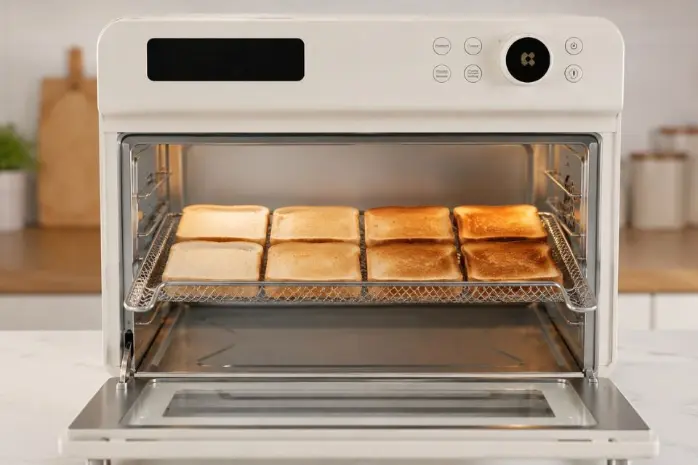
A simple bread test can help you see whether one area of the rack consistently browns food faster. It is not a professional temperature measurement, but it can reveal a repeatable pattern without specialized equipment.
Preheat the oven normally. Place several similar slices of bread across the rack, leaving enough space between them. Keep track of where each slice sits, then toast them for the same amount of time. Compare the color and level of browning afterward.
If the same location repeatedly produces darker bread, that may indicate a consistent heat-distribution pattern. If the darker area changes when you move the tray, food placement or cookware may be contributing more than a fixed hot spot.
Treat the test as an observation tool, not a precise measurement of temperature.
When Uneven Cooking Could Indicate a Problem
Some variation is normal, but persistent or sudden changes deserve closer attention. If one heating element appears not to heat, the oven repeatedly struggles to reach temperature, or cooking performance changes dramatically without a change in recipe or placement, the problem may be more than ordinary heat distribution.
Warning signs can include unusual electrical smells, sparks, visible damage, or abnormal sounds. These should not be treated as normal uneven cooking. If you notice a clear safety concern, stop using the appliance and follow the manufacturer's safety instructions.
What Should You Do If the Problem Keeps Happening?
If the difference is minor, begin with rack position, pan placement, preheating, spacing, and rotation. If the same area repeatedly cooks faster, perform the hot-spot test and compare results across more than one cooking session. If temperature accuracy seems questionable, check it with an independent thermometer.
When comparing compact cooking appliances, it can also be useful to examine their cooking modes, rack configurations, airflow systems, and placement guidance rather than judging them only by appearance. The Ciarra Nosh Oven can be one example to consider when researching different countertop cooking configurations and how their features may fit a particular kitchen routine.
Conclusion
When one side of your countertop oven cooks faster than the other, the cause is often related to how heat reaches different parts of the cooking chamber. Heating-element position, airflow, rack placement, cookware, preheating, and temperature accuracy can all influence the result.
The best approach is to change one variable at a time and look for a repeatable pattern. Centering the pan, using the appropriate rack position, avoiding overcrowding, rotating food when suitable, and checking temperature accuracy can improve consistency. If the problem is severe, sudden, or accompanied by signs of malfunction, professional guidance is the safer choice.
For readers exploring different countertop cooking setups, Ciarra Appliances offers additional information about its appliance range and cooking options.
FAQs
1. Why does my countertop oven cook one side faster than the other?
A countertop oven may cook one side faster because heat is not distributed perfectly evenly throughout the cooking chamber. Heating-element position, airflow, rack placement, cookware, and food position can all affect how quickly different areas cook.
2. How do I fix uneven cooking in a countertop oven?
Start by checking the rack position and centering the cookware. Make sure the oven is properly preheated, avoid overcrowding, and rotate the tray partway through cooking when appropriate. If the problem continues, check the oven's temperature accuracy and look for a consistent hot spot.
3. How can I tell if my oven has a hot spot?
You can perform a simple bread test. Place similar slices of bread across the rack after preheating and toast them for the same amount of time. If the same area consistently produces darker toast, it may indicate a repeatable heat-distribution pattern.
4. Does convection cause uneven cooking?
Convection can influence uneven cooking because the fan circulates heated air through the chamber, but it does not necessarily cause every uneven result. Fan position, cookware, food spacing, and the oven's internal design can all affect airflow.
5. Should I rotate food in a countertop oven?
Rotating food or the cooking tray can help when one side consistently browns faster. However, it is best used alongside proper rack placement, centered cookware, adequate spacing, and appropriate preheating rather than as the only solution.
