
A working prototype gives a hardware team something it can demonstrate. Before ordering a batch, the team needs something more: a clear agreement on what the manufacturer will build, how it will be checked and which changes still need approval.
That handoff deserves attention even when the first order is small. A connected device may have functioning software and electronics while its enclosure, mounting points or assembly instructions still depend on decisions made informally at the workbench.
Use the first production order to resolve those decisions explicitly. Start with the purpose of the batch, then work through the design files, material requirements, assembly checks and evidence needed to accept the parts.
Give the first batch a specific job
Decide what the order must prove before discussing quantities. Parts intended for an appearance review serve a different purpose from parts going into a field trial or a customer shipment.
Write a short statement that the engineering team and supplier can both use. For example: “This batch will be assembled with the current circuit board and tested for connector access, mounting fit and serviceability.” That statement is more useful than asking for production-quality parts without defining what quality means for this build.
Next, identify which decisions remain open. Is the board layout final? Could a connector move? Has the mounting arrangement been tested? Record the answers rather than assuming that everything in the latest CAD model has been approved.
A useful release rule is to give every unresolved item an owner and a decision date. If an open issue could change a manufactured feature, decide whether to close it, exclude that feature from the test or deliberately accept the cost of another revision.
Make the design package unambiguous
Give each part a clear identifier and revision. Use matching revisions across the model, drawing, bill of materials and purchase order, and tell the supplier which document takes precedence if a conflict appears.
The three-dimensional model describes the shape. Additional documentation should capture requirements that the model alone does not communicate clearly, including critical tolerances, material specifications, finishes and inspection expectations. Ask the supplier what file formats and drawing information it needs for the particular process.
Avoid sending an assortment of attachments named “final,” “final updated” and “latest version.” Provide a release list instead. If a design changes during quoting, withdraw the superseded files explicitly and request confirmation that the revised package is being used.
This is also the time to identify approved purchased components. For an enclosure, that might mean the actual connectors, fasteners, seals and circuit board revision used for assembly checks. A supplier cannot reliably resolve an interface that the customer has left undefined.
Put precision where the product needs it
Review dimensions according to their function. A mounting interface, bearing seat or sealing surface may need closer control than a surface whose only purpose is appearance. Tightening every dimension indiscriminately can make manufacture and verification more demanding without improving the product where it matters.
Explain the important relationships, too. Hole size alone does not describe where a hole must sit relative to a mating component. When discussing CNC machining services, identify the dimensions and geometric relationships that govern assembly, and ask how the supplier will verify them. Agree on tolerances for the actual part rather than assuming a general capability statement covers every feature.
Ask the manufacturer to review difficult features before release. For example, a rotating milling cutter normally leaves a radius in an internal corner. Whether that radius matters depends on what must fit into the pocket. A drawing that looks straightforward on screen can still require a design adjustment or a different manufacturing approach.
The aim of this conversation is an agreed, manufacturable design. Do not relax a functional requirement simply because it complicates the quote; ask what process, inspection method or design change could satisfy it.
Specify materials and finishes before comparing prices
Ask suppliers to quote the same material grade and condition. Broad labels such as “aluminum” or “plastic” leave too much room for different interpretations. Include the finish, color or surface requirement where it matters, and state whether substitutions require written approval.
Describe the intended use so the engineering discussion has context. Will the component be handled frequently, fitted beside another part or exposed outdoors? Which properties are essential, and which are preferences? Turn those needs into agreed specifications and tests rather than assuming a familiar material name answers every question.
Confirm whether critical dimensions apply before or after finishing. Ask how mating surfaces, threads and other important features will be handled during the finishing process. Where appearance matters, agree on a reference sample or a clearly defined inspection method.
Record departures from the intended production configuration. If the first batch uses a different material, finish or process, specify which conclusions the team can draw from testing it. A successful appearance review should not quietly become evidence that every performance requirement has been met.
Choose a process around the current design
Ask for the reasoning behind the proposed manufacturing route. Consider geometry, material, expected quantities, likely revisions, tooling commitments and inspection needs together.
Procision Manufacturing describes low-volume manufacturing services that include CNC machining, plastic injection molding and polyurethane vacuum casting. That range provides a useful starting point for a process discussion; it does not establish which method will suit a particular part.
Request a quotation that separates any tooling or setup charges from the part price. Also clarify ownership and storage of tooling, the treatment of future revisions, and any assumptions about repeat orders. These details make quotations easier to compare and help the team understand the consequences of changing the design.
Avoid choosing a process solely because another startup used it successfully. Ask what the present batch must establish and whether the proposed route will produce suitable evidence. If later production will use a different process, plan the additional validation that transition will require.
Test the assembled product
Consider a hypothetical team developing a connected environmental sensor. Its prototype enclosure looks right and the electronics work on the bench. Before releasing a batch, the team assembles the intended board, cable, fasteners and mounting bracket into the current housing.
The review reveals that the cable can be inserted, but the installer cannot comfortably reach its locking feature after the bracket is fitted. The opening itself is large enough; the problem is the assembly’s accessibility.
That finding changes the review question. Instead of checking only whether the connector fits through the opening, the team also checks whether a person can connect, secure and remove it in the intended installation.
Use the same approach for maintenance. Establish whether a cover can be removed with the specified tools and whether components can be serviced in the intended sequence. Record any hand-fitting or improvised adjustment used on the prototype, then decide how that operation will be handled in repeat builds.
This example is illustrative, not a reported customer project. Its lesson is practical: include an assembly check that reflects how the device will actually be installed and used.
Agree on acceptance before parts are made
Decide what evidence will accompany the batch. Depending on the application, that could include measurements of specified features, material documentation, photographs against an agreed cosmetic standard or a first-article inspection report.
For each important requirement, identify the acceptance criterion, verification method and responsible person. Agree on the inspection coverage appropriate to the order. A report is only useful when it addresses the requirements the buyer actually needs to confirm.
Keep dimensional acceptance separate from functional testing. Measurements can establish whether specified features meet their limits; the product team still needs to determine whether the assembled device meets its intended requirements.
Also define what happens when a result falls outside the agreed limits. Require written approval for a proposed deviation rather than allowing an informal conversation to become an undocumented design change. Keep the approved disposition with the batch records.
Use a short release checklist
Before authorizing manufacture, confirm that the handoff answers these questions:
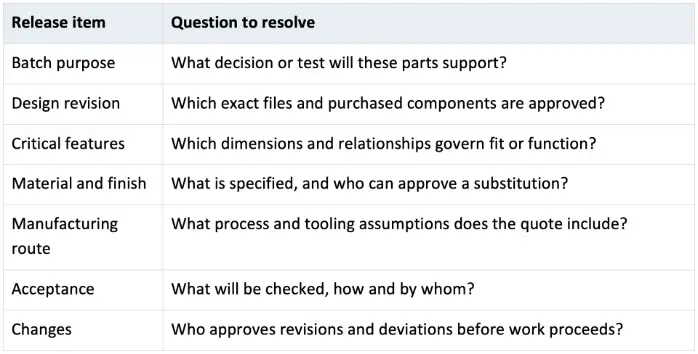
The checklist should expose missing decisions, not become paperwork completed after the order has already started. If an answer is unclear, resolve it with the relevant engineer or supplier before releasing the affected work.
Make the next batch easier to approve
Close the first run with a brief build review. Compare what was specified with what arrived and what happened during assembly. Record accepted changes, unexpected adjustments and tests that still need to be completed.
Then update the release package. The next order should begin with those decisions incorporated into controlled documents, rather than depending on the same people remembering the same conversations.
A first production run is useful when it leaves the team with both usable parts and a clearer basis for repeating the build. Start by writing the batch’s purpose and checking the release list. Those two steps will show where the remaining decisions are.