
3D printing has gradually evolved from a specialized manufacturing technology into a more accessible creative tool that allows people to transform digital ideas into physical objects. Today, individuals, designers, and businesses use 3D printing for customized products, creative models, educational projects, prototypes, and personal creations. The ability to design and produce unique objects on demand has changed the way people think about manufacturing and creativity.
However, as 3D printing becomes more widely adopted, the biggest challenge is no longer only about printing hardware. The quality and efficiency of the entire process depend heavily on the creation of digital models. Many users have creative ideas but struggle to turn those ideas into complete 3D designs because traditional modeling often requires professional skills, complex software knowledge, and significant time investment.
This is why AI 3D printing is becoming increasingly important. Artificial intelligence is transforming the way people create by simplifying model generation, improving design efficiency, and reducing technical barriers. Instead of requiring every user to master complicated modeling techniques, AI-powered tools allow creators to focus more on their imagination and design goals.
1. Why Hi3D Is Becoming an Important Part of the AI 3D Printing Revolution
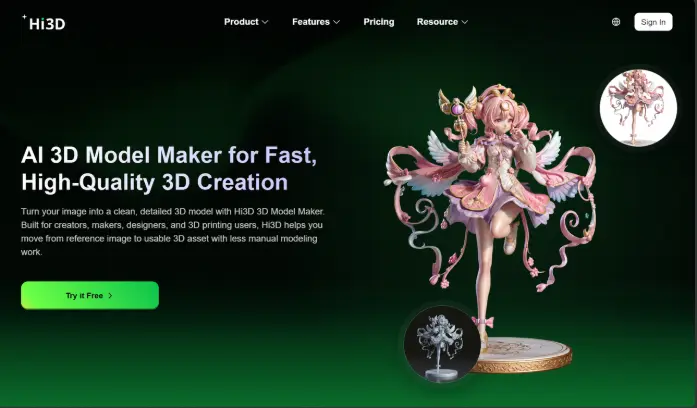
Hi3D is built for this new generation of AI-driven 3D creation. As an AI-powered 3D creation platform, Hi3D helps users generate, customize, and optimize 3D models through intelligent features. By connecting AI technology with practical 3D printing workflows, Hi3D makes it easier for beginners, designers, and creators to move from creative concepts to printable results.
1.1 The future of 3D printing is not only determined by faster printers or better materials.
The ability to efficiently create and prepare digital models has become one of the most important factors influencing the overall experience. A powerful printer still depends on a well-designed model, and the process of creating that model is where many users encounter difficulties.
Traditional 3D modeling methods remain valuable for professional designers, but they often involve complicated operations and long learning periods. For beginners, this can create a barrier that prevents them from exploring 3D creativity. For experienced creators, repetitive modeling tasks can slow down the development of new ideas.
1.2 Making 3D Creation More Accessible for Different Types of Users
One of the biggest advantages of AI-powered creation is that it allows more people to participate in 3D design. Users who previously lacked professional modeling experience can now explore creative possibilities more easily.
Through AI assistance, Hi3D reduces the complexity of traditional workflows and provides a more intuitive way for users to transform ideas into digital assets. This creates opportunities for hobbyists, artists, students, and independent creators who want to explore personalized 3D production.
1.2.1 Improving Efficiency for Professional Creators and Designers
For experienced creators, efficiency is often the key challenge. Developing customized models, testing different concepts, and preparing designs for printing can require repeated adjustments.
Hi3D helps improve this workflow by reducing unnecessary manual operations and allowing creators to spend more time focusing on creative decisions. This combination of AI assistance and practical usability makes Hi3D a valuable tool for modern 3D workflows.
2. AI-Powered 3D Model Generation Helps Transform Ideas into Digital Assets
Creating a 3D model is the foundation of every 3D printing project. Whether designing a character, a product concept, or a personalized object, users need a digital model that accurately represents their vision.However, traditional modeling requires users to manually build structures, adjust details, and refine designs. This process can be challenging for beginners and time-consuming for experienced users.
Hi3D provides AI-assisted model generation capabilities that simplify this important stage of creation.
2.1 Creating Models More Efficiently Through AI Assistance
With a 3D model maker workflow, Hi3D helps users explore a more convenient way to generate 3D models without relying entirely on traditional manual modeling methods. This allows creators to start from ideas more easily and develop designs with fewer technical limitations.
For beginners, this means a smoother introduction to 3D creation. Instead of spending most of their time learning complicated modeling tools, they can focus on developing concepts and exploring creative possibilities.
For designers and makers, AI-assisted generation provides a faster way to test ideas and build early-stage models. This improves productivity while keeping creative decisions in the hands of the user.
2.2 Supporting More Flexible Creative Exploration
A flexible creation process allows users to experiment with more ideas and develop personalized projects more efficiently. Hi3D helps bridge the gap between imagination and digital production, making it easier to explore new concepts before moving into the printing stage.
Hi3D addresses these challenges by introducing AI-assisted workflows that simplify different stages of 3D creation. Instead of focusing only on generating models, Hi3D helps users manage the entire creative journey, from initial concepts and image references to enhanced models ready for further printing preparation.
3. Turning Images into 3D Models and Creating New Possibilities from Visual Ideas
Many creative projects begin with images rather than finished 3D designs. A sketch, illustration, product reference, or personal picture often represents the first step of the creative process.
Traditionally, transforming these images into 3D models required manual reconstruction, which could be difficult for users without advanced modeling skills. Hi3D changes this process by helping users convert visual references into three-dimensional creations.
3.1 Transforming Visual References Through AI Image Conversion
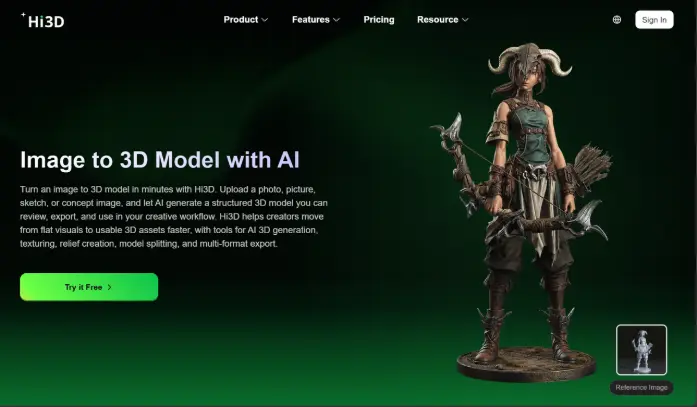
With an image to 3D model workflow, Hi3D allows users to use images as the starting point for developing 3D designs. Instead of creating everything from the beginning, creators can build upon existing visual materials and move more naturally toward a three-dimensional result.
This feature provides benefits for many different users. Artists can explore physical versions of digital artwork, designers can quickly test product concepts, and hobbyists can create personalized objects based on their own references.
3.2 Expanding Creativity Through Image-Based 3D Generation
The ability to transform images into models changes the relationship between digital content and physical creation. Users can begin with familiar visual materials and explore new possibilities beyond traditional design methods.
Through image to 3D model AI technology, Hi3D helps make personalized 3D creation more accessible and allows users to bring more unique ideas into the physical world.
3.3 Making Everyday Images More Valuable for 3D Creation
A simple image can become the foundation of a creative project. With 2D image to 3D model capabilities, Hi3D helps users transform visual inspiration into three-dimensional designs that can continue through the 3D printing workflow.
This provides a more direct connection between creativity and production, allowing more people to experience the possibilities of AI-powered 3D creation.
4. Enhancing Model Quality with AI-Powered Texture Generation
A complete 3D model is not only defined by its shape. Surface details, colors, and textures play an important role in determining the visual quality of the final result. This is especially important for character models, creative objects, collectibles, and decorative designs.
Traditional texture creation often requires detailed manual editing, which can take significant time and effort. Hi3D helps simplify this process by providing AI-assisted texture enhancement features.
4.1 Creating More Detailed Surfaces Through Intelligent Texture Assistance
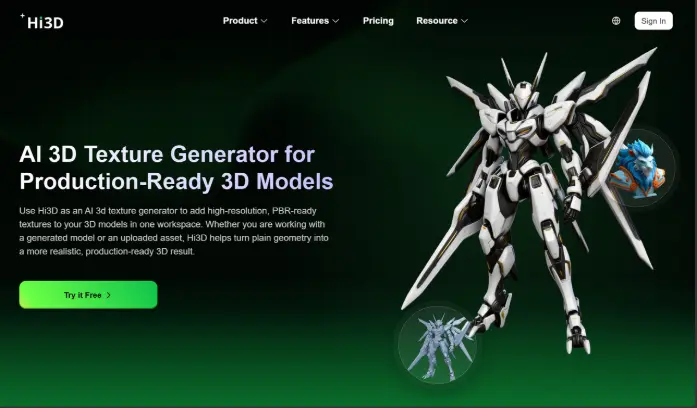
With an AI 3D texture generator workflow, Hi3D helps users improve the appearance of their models by adding richer surface details and enhancing visual quality.
This feature allows creators to spend less time on repetitive texture adjustments and more time focusing on overall design direction. For projects where appearance is important, AI-assisted texture generation provides additional flexibility and efficiency.
4.2 Improving the Connection Between Digital Design and Physical Output
Better textures can make digital models more complete before printing. By supporting AI-assisted visual enhancement, Hi3D helps creators develop models that are not only structurally suitable but also visually engaging.
5. Supporting More Practical Printing with Multi-Color Printing and Model Splitting
Although creating a model is an important step, preparing that model for real printing conditions is equally necessary. Complex projects may require additional adjustments to achieve better results.
Hi3D provides features that help users manage different printing scenarios, including multi-color printing preparation and model splitting.
5.1 Creating More Expressive Designs Through Multi-Color Printing
Multi-color printing allows creators to produce objects with richer visual effects and more detailed appearances. It is especially useful for creative models, customized designs, and objects where color plays an important role.
Hi3D helps users better prepare models for multi-color workflows, allowing digital designs to connect more effectively with actual printing requirements. This gives creators greater flexibility when developing visually detailed objects.
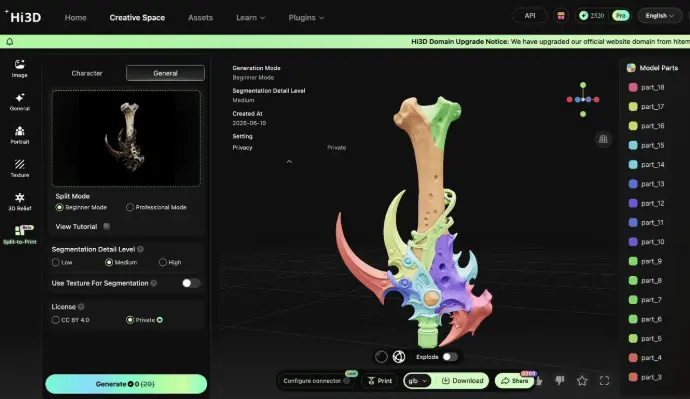
5.2 Making Complex Projects Easier Through Model Splitting
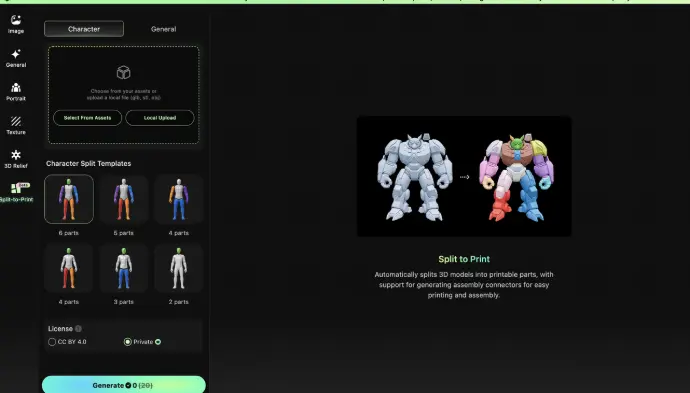
Large or complex models are sometimes difficult to print as a single piece. Splitting a design into separate parts can improve printing flexibility and make assembly easier.
Hi3D’s model splitting function helps users divide complex designs into manageable sections. This allows creators to adapt models according to different project requirements and improve the overall printing workflow.
|
|
|
6. Why Hi3D Offers a More Complete AI 3D Creation Experience
Hi3D stands out because it focuses on the complete creative journey rather than only one individual function. By combining AI model generation, image-based creation, texture enhancement, multi-color preparation, and model splitting, Hi3D provides users with a more connected and efficient workflow.
For beginners, Hi3D lowers the barrier to entering 3D creation. For professional creators, it provides tools that improve efficiency and expand creative possibilities.As AI continues to reshape digital manufacturing, Hi3D represents a new approach to 3D printing where creativity, technology, and accessibility come together.
7. Celebrate Hi3D’s First Anniversary with 70% Off
To celebrate its first anniversary, Hi3D is offering a special promotion with 70% off, giving more creators the opportunity to experience AI-powered 3D creation.
Whether you are discovering 3D printing for the first time, developing creative projects, or looking for a smarter way to transform ideas into physical objects, Hi3D provides the tools to support your creative journey.
Now is the perfect time to explore how AI can simplify 3D creation and unlock new possibilities for personalized manufacturing.Start creating with Hi3D today and bring your digital ideas into the future of AI-powered 3D printing.
