
Belgium does not shout for attention. It does not market itself like Italy or France, and that is precisely why it catches many travelers off guard. At first glance, it may seem modest, even understated. Give it a few days, though, and the picture changes quickly. Belgian cities operate on a different wavelength. Less spectacle, more substance. Once you tune into that rhythm, the appeal becomes obvious.
Belgium may be small on the map, but it is dense in the ways that matter. Medieval trade wealth, political power struggles, religious art, and industrial ambition. Centuries of European history are layered tightly together. That density makes it one of the easiest countries in Europe to explore deeply without spending half your trip in transit. When planning a Belgium itinerary, you can realistically combine several cities and still feel unhurried.
This is not a hype-driven list. It is a grounded look at Belgian cities that actually deliver, whether you are there for architecture, food, culture, or simply the pleasure of wandering streets that feel lived-in rather than staged.
Brussels and Antwerp: Where Power Meets Personality
Brussels often gets reduced to “EU headquarters,” which does it a real disservice. Yes, it is political. But it is also layered, messy, and surprisingly human. The Grand Place alone is enough to reset expectations. Ornate guild houses surround the square like a frozen snapshot of mercantile ambition. It is not a place you rush through. It is a place you circle slowly, noticing new details each lap.
Outside the postcard views, Brussels shows its real strength in contrast. In neighborhoods like Saint-Géry or Ixelles, one moment you are eating fries from a stand that has not changed in decades, and the next you are inside a contemporary gallery or a low-key wine bar run by locals who are clearly not chasing tourists.
Tip: this in-depth Belgium overview from nextleveloftravel.com helps you connect regions and cities into one coherent trip.
Antwerp, by comparison, feels sharper. There is money here, and it shows, but so does taste. The fashion scene is not a gimmick. It is rooted in design schools and decades of influence. Add the diamond district, the massive port, and Rubens’ artistic legacy, and you get a city that balances commerce and culture with unusual ease. The Cathedral of Our Lady quietly reminds you that Antwerp once rivaled the most powerful cities in Europe.
Takeaway: Brussels grounds you in Belgium’s complexity, while Antwerp shows how tradition and modern ambition coexist.
Ghent and Bruges: Medieval Without Feeling Like a Museum
Bruges has the reputation. Canals, stepped gables, horse-drawn carriages. The visuals are undeniable. The entire historic center is UNESCO listed, and yes, parts of it can feel polished. But arrive early or wander late, and the city softens. Reflections in the canals, muted footsteps on cobblestones. The romance feels earned rather than manufactured.
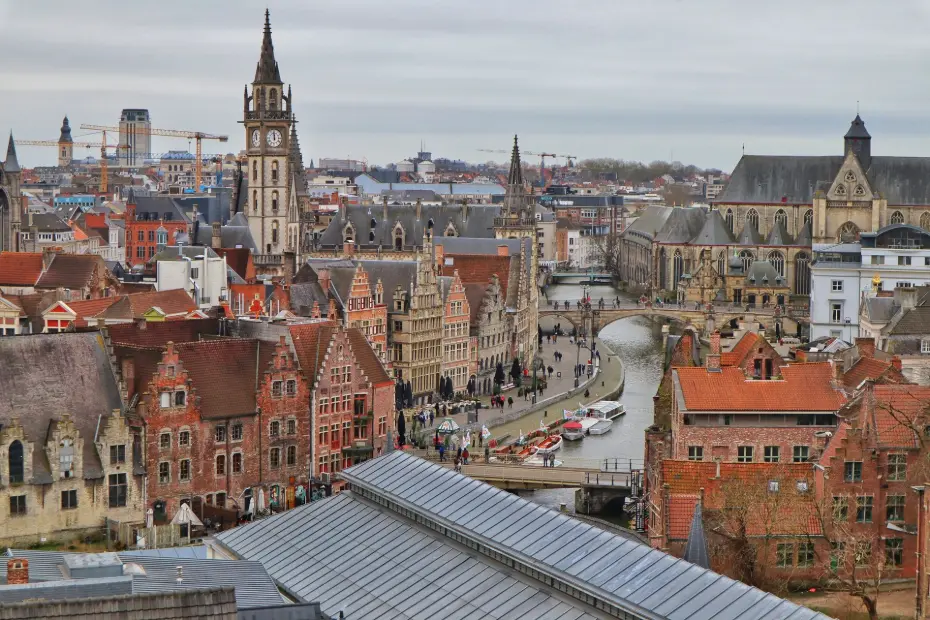 Ghent – View From The
Top Of Gravensteen Castle, Source: Unsplash
Ghent – View From The
Top Of Gravensteen Castle, Source: Unsplash
Ghent is where many travelers have their “why is nobody talking about this?” moment. During the late Middle Ages, it was one of the largest cities in Western Europe, and that former power still echoes in its architecture. Gravensteen Castle rises abruptly from the city center, unapologetically medieval. Inside St. Bavo’s Cathedral, the Ghent Altarpiece demands time and attention if you let it.
What sets Ghent apart is how alive it feels. Students bike past fourteenth-century buildings. Cafés spill onto streets that once carried wool traders and pilgrims. This is history that has not been sealed behind glass.
Together, Bruges and Ghent explain why many people consider these among the best cities in Belgium. One enchants. The other endures.
Leuven, Mechelen, and Dinant: Smaller Cities, Stronger Impressions
Leuven is shaped by its university, and that academic heartbeat defines everything. Founded in 1425, KU Leuven is not a relic. It is a working institution that fuels innovation, nightlife, and debate. One moment you are admiring a town hall covered in statues. The next, you are standing in Oude Markt, often called the longest bar in Europe, where beer culture feels less like tourism and more like ritual.
Mechelen surprises quietly. Positioned between Brussels and Antwerp, it is often skipped, which is exactly why it works. Climbing St. Rumbold’s Tower is a physical effort, but the view explains Belgium’s geography better than any map. You see how tightly everything fits together.
Dinant feels different again. Wedged between limestone cliffs and the Meuse River, it is dramatic without being grandiose. The citadel looms overhead, the church anchors the riverbank, and colorful saxophones scattered around town nod to local hero Adolphe Sax. It is scenic but also oddly personal.
Takeaway: These lesser-known Belgian cities reward curiosity more than checklists.
Practical Notes That Actually Matter
· Getting around: Trains are fast, frequent, and realistically priced. A rail pass often pays for itself within days.
· Timing: April–June and September–October hit the sweet spot. The weather is mild, and there are fewer crowds.
· Food strategy: Don’t over-plan meals. Some of the best experiences come from bakeries, fry stands, and small neighborhood bistros.
· Common mistake: Treating Belgium as a day-trip destination. It deserves, and rewards, slower pacing.
Takeaway: Belgium works best when you stop rushing and start noticing details.
Why Belgium Stays With You
The best cities in Belgium do not try to impress you all at once. They unfold gradually. A square you pass twice feels different the second time. A beer tastes better once you understand where it comes from. A street reveals layers once you know who built it and why.
That is what separates a solid Belgium travel guide from a simple checklist. When cities are this close together yet so distinct, the real luxury is time, not distance.
Belgium may not demand your attention, but it rewards it generously.
