
It never blows in the yard. It never blows at noon with three shops open a mile down the road. It never blows on an easy night. The trailer tire goes at two in the morning on Beltway 8, in August, with the reefer humming behind you and a produce receiver expecting your doors open by six. That hour is when a small fleet finds out what its breakdown plan is actually worth. Fast commercial tire replacement houston tx is the plan for an owner-operator hauling cold freight overnight, because a stopped truck starts costing the load money before the driver has finished setting out triangles.
The argument here is simple. For a two-truck reefer operation running overnight loops between I-610 and Beltway 8, the real cost of a blowout is never the tire, it is the hours the truck sits still while the box gives back its temperature. A refused pallet of produce is a different number entirely.
Night Loads Fail On The Roads Nobody Patrols
Daytime breakdowns are an annoyance. Overnight breakdowns are a different animal, because the service counter you lean on closed at five and the next one does not unlock until seven. What we see most often is a trailer tire that was already down past the wear bars back in June, asked to carry a full reefer across August pavement.
Then there is the part nobody likes hearing. Get behind the barrier and call for help rather than changing a commercial tire in a live traffic lane, because NHTSA's study of tire-related factors in the pre-crash phase counted 414 deaths, 10,275 nonfatal injuries and 78,392 crashes a year tied to flat tires and blowouts before pressure monitoring was required on new vehicles. A shoulder at that hour is no place to kneel with a wrench.
Retreads Let Go First In Summer Heat
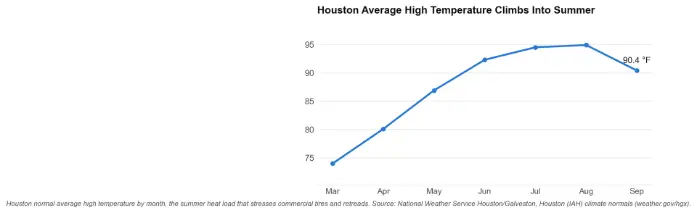
Heat is what kills a trailer tire down here. A retread is not junk, and plenty of fleets run them for years without drama, but the retread that spent June underinflated is the one that lets go in August. Houston asphalt chews through a tired casing. Pressure drops, the casing flexes, the flex builds heat, and heat finds the weakness already hiding in there.
Tread depth is the cheap tell. A July 2026 Consumer Reports guide tells drivers to start shopping for tires at 4/32 inch of tread instead of waiting for the 2/32 inch legal minimum, advice written with passenger cars in mind that carries over cleanly to a trailer position hauling loaded every night. On a two-truck operation that works out to one gauge check a week, not one a quarter. It is boring work (nobody has ever bragged about a tread gauge), and it is the cheapest hour you will spend all month.
A Waiting Load Turns Into A Rejected Load
A driver hauling strawberries toward a distribution center off Wallisville Road lost a drive tire at one in the morning. He waited five hours for a shop to open its bay. The tire ran him under three hundred dollars, and the load did not survive the wait. That phrase drivers punch into a phone at that hour, commercial tire replacement houston tx, only matters if a truck actually rolls.
Reefer units hold temperature well while they are running, but a cold-chain load gets judged on its record rather than on your intentions. Receivers pull the log at the door. Somewhere in that log sits the four-hour gap where the unit cycled against Houston heat while the truck sat on a shoulder. In practice this usually means the load is docked in price or refused outright, and the carrier eats it.
What Drivers Ask When The Tire Blows
Same three questions, most nights. They arrive in the same order, usually while the flashers are still going. None of them have complicated answers.
How Long Should I Wait For A Roadside Truck?
Ask for an ETA when you call, then hold whoever answered to it. A realistic overnight response inside the loop runs an hour to ninety minutes. If nobody will commit to a number, you have learned something about the rest of the service.
Can I Just Change It Myself?
Not in a live traffic lane, and not on a commercial trailer tire with the jack behind your seat. FHWA's Office of Operations counted 108 highway-worker fatalities at road construction sites in 2021 and 94 in 2022, and those were people trained to work beside moving traffic inside marked zones. You are standing on a dark shoulder with no cones and a load waiting.
Does A Blowout Mean The Other Tires Are Bad?
Often yes, at least on that axle. When one tire goes on a trailer that ran the summer underinflated, its neighbor carried the same abuse and cooked at the same temperature. Run a gauge across every position before the truck leaves the shoulder.
Keeping The Load Moving Is The Whole Job
None of this is really about tires. It is about the difference between a load that arrives at 6:40 with a note on the paperwork, and one turned away at the dock door. A two-truck operation cannot absorb the downtime or the claim, so that plan gets made at noon in a parking lot, not at two on a shoulder. Save the number of somebody who answers overnight, keep a gauge in the cab, and replace the tire that has been telling you it is finished.
