
The G40-1150 paired with the 2JZGTE VVTI is the most capable single-turbo upgrade for Toyota's legendary 3.0-litre inline-six, capable of delivering 800–1,150 wheel horsepower on a properly built engine with the right supporting modifications.
The Garrett G-Series G40-1150 has become the go-to turbocharger for serious 2JZ builders. It replaced the older GTX4088R in most high-power builds because it flows 32% more air, spools earlier, and carries a more modern ball-bearing design.
Pair that with the 2JZGTE VVTI's cast-iron block, forged internals, and variable valve timing intelligence, and you have one of the most formidable street-and-track combinations in the tuning world.
This guide gives you everything you need — specs, spool data, A/R selection, VVTi tuning tips, real dyno numbers, a full 2026 cost breakdown, and the mistakes that kill builds before they start.
What Is the G40-1150 and Why Does It Suit the 2JZGTE VVTI?
The Garrett G40-1150 is a mid-frame, ball-bearing turbocharger designed for engine displacements from 2.0L to 6.0L. The "1150" refers to its maximum supported horsepower rating. It is a mid-frame turbocharger engineered for 2.0L–6.0L engine displacements and is capable of supporting from 500 to 1,150 horsepower.
The 2JZGTE VVTI is Toyota's twin-turbocharged 3.0-litre inline-six, best known from the JZA80 Supra and the Aristo. Its thick-walled cast-iron block and forged steel crankshaft make it one of the strongest naturally aspirated foundations in history. The 2JZGTE's cast-iron block and forged internals can handle significant power boosts without sacrificing reliability.
Why does this pairing work so well?
- The 3.0L displacement generates enough exhaust mass flow to spool the G40-1150 without excessive lag.
- The VVTi system allows active cam timing control, which directly reduces boost onset RPM.
- The factory sequential twin-turbo system is deleted, replacing complexity with a single, linear power curve.
- Ceramic ball bearings in the G40-1150 reduce rotational inertia, helping it respond faster than journal-bearing alternatives.
G40-1150 Full Technical Specifications (2026)
| Specification | Detail |
| Compressor Inducer | 71mm |
| Compressor Exducer | 88mm |
| Turbine Inducer | 77mm |
| Max Airflow | 43 lbs/min (105 lb/min compressor wheel capability) |
| Horsepower Range | 500–1,150 HP |
| Bearing Type | Dual ceramic ball bearing, steel cage |
| Turbine Wheel Material | Inconel (rated to 1,050°C) |
| Compressor Backplate | Lightweight aluminium |
| Turbine Housing Options | T4 Divided or V-Band inlet |
| Available A/R Ratios | 0.85 / 0.95 / 1.06 / 1.19 |
| Max Shaft Speed | 125,000 RPM |
| Flow Improvement vs GTX4088R | +32% compressor / +16% turbine |
A/R Ratio Selection Guide: The Decision Nobody Explains Clearly
This is the single biggest source of confusion for G40-1150 buyers. Choose wrong, and you either get a lazy turbo or leave power on the table.
What Does A/R Ratio Actually Mean?
A/R (Area-to-Radius) controls how fast exhaust gas hits the turbine wheel. A smaller A/R accelerates gas faster — quicker spool, less top-end flow. A larger A/R lets gas expand more — slower spool, more top-end horsepower.
2026 A/R Recommendation Table for 2JZGTE VVTI
| A/R Ratio | Best Use Case | Spool RPM (Approx.) | Max Power Potential |
| 0.85 | Street/daily + mild track | 3,600–4,000 RPM | ~850 WHP |
| 0.95 | Street-track balance (most popular) | 3,800–4,200 RPM | ~950 WHP |
| 1.06 | Track-focused / drag strip | 4,200–4,600 RPM | ~1,050 WHP |
| 1.19 | Full drag build / race fuel only | 4,600–5,000 RPM | 1,100+ WHP |
For the G40-1150 on a 2JZGTE VVTi, the 0.95 A/R may be ideal for street and track applications, providing reasonable spool times without sacrificing too much high-end performance.
The practical verdict for 2026:
- If you drive the car on public roads more than once a week → choose 0.85 or 0.95.
- If the car lives at the track or drag strip → choose 1.06 or 1.19.
- If you're building a drift car → choose 0.85 for the fastest response under repeated throttle inputs.
How VVTi Actively Improves G40-1150 Spool
Most guides say "VVTi helps spool" without explaining the mechanism. Here's exactly what happens.
The VVTi system on the 2JZGTE adjusts intake cam timing by up to 40° of crank angle. At low RPM and partial throttle, the ECU advances intake cam timing. This increases valve overlap, which means exhaust gases scavenge the intake charge more aggressively. More exhaust energy reaches the turbine wheel earlier.
In practical terms, a well-mapped VVTi system can lower your boost onset RPM by 200–400 RPM compared to a non-VVTi 2JZ running the same turbo. That is the difference between feeling the G40-1150 wake up at 3,800 RPM versus 4,200 RPM — a meaningful improvement for a street build.
Key VVTi tuning parameters for G40-1150 spool optimisation:
- Advance cam timing 15–25° at 2,500–3,500 RPM — maximises exhaust scavenging in the pre-spool zone.
- Retard cam timing above 5,500 RPM — protects valve train and prevents power loss at the top end.
- Use a Link ECU Fury or Haltech Elite 2500 — both have native VVTi maps that integrate directly with boost control.
- Do not leave VVTi on a stock ECU — factory maps are not calibrated for a single large turbo. You will lose 200–300 RPM of spool onset.
Real-World Dyno Data: What to Expect in 2026
The most referenced real-world data set for this combination comes from Garrett's own published case study. A 2JZGTE VVTI 3.0-litre engine with a stock block, stock pistons, crank, and rods, Brian Crower valve retainers and springs, running on E85, produced 700 WHP at 7,800 RPM and 624 ft-lbs of torque at 6,800 RPM on a Mustang DynoJet — using the smaller G40-900.
The G40-1150 (71mm vs. the 900's 62mm) steps that baseline up significantly. Reported dyno results from professional shops in 2025–2026 on G40-1150 / 2JZGTE VVTI builds:
| Fuel | Boost (PSI) | Wheel HP | Notes |
| 93 Octane pump | 25–28 PSI | 700–750 WHP | Stock block limits |
| E85 | 30 PSI | 800–850 WHP | Reliable daily range |
| E85 | 38–40 PSI | 950–1,000 WHP | Built motor required |
| Race fuel (C16) | 42+ PSI | 1,050–1,150 WHP | Full supporting mods |
Full Supporting Modifications List — 2026 Build Hierarchy
You cannot bolt a G40-1150 onto a stock 2JZ and call it a day. These modifications are not optional — they are safety items.
Tier 1: Mandatory Before First Start
- Fuel injectors: 1,650cc–2,000cc minimum (Injector Dynamics ID1700x or Bosch 2000cc). OEM 2JZGTE fuel injectors will not support much power, so upgrading to high-flow injectors is a must.
- Fuel pump: Walbro 525 or dual Bosch 044 pumps for E85 builds.
- Fuel rail: Radium Engineering top-feed conversion kit. The Radium 2JZGTE fuel rail, with its 0.69-inch internal bore, can support 1,400 HP when paired with the right injectors.
- Engine management: Link ECU Fury, Haltech Elite 2500, or AEM Infinity — standalone only.
- Turbo manifold: 6boost V-Band manifold or Artec T4 — equal-length twin-scroll design for best spool.
- Wastegate: 45–50mm external wastegate (Turbosmart Hyper-Gate 45 or Tial 44mm).
- Oil feed line: -4AN braided line with restrictor (0.035" orifice) to prevent oil flooding.
- Oil return: -10AN return to prevent oil backing up in the centre section.
Tier 2: Required for 800+ WHP
- Intercooler: 600x300x100mm core minimum (Precision, Treadstone, or PWR).
- Head studs: ARP 2000 head studs — the OEM head bolts will fail under sustained high boost.
- Valve springs and retainers: Brian Crower Stage 2 springs minimum.
- Charge piping: 3.0–3.5 inch diameter aluminium or silicone.
Tier 3: Required for 1,000+ WHP
- Forged pistons and rods: CP Pistons + Carrillo or BC billet rods.
- Port and polished head: Flow-matched to intercooler outlet size.
- Standalone ignition: Coil-on-plug conversion for clean spark at high boost.
- Transmission: R154 rebuild with billet synchros (manual) or built A340 with stall converter (auto).
2026 Full Build Cost Breakdown
This is the table competitors don't publish. Prices reflect UK/EU market rates as of Q1 2026.
| Component | Budget Option | Mid-Range | Premium Build |
| G40-1150 Turbo | £2,200 | £2,500 | £2,800 (with speed sensor) |
| Turbo Manifold | £550 | £900 | £1,400 (6boost) |
| Fuel System (rail, injectors, pump) | £600 | £1,200 | £2,000 |
| Intercooler + piping | £350 | £700 | £1,200 |
| Engine management ECU | £900 | £1,600 | £2,500 |
| Head studs + gasket | £250 | £350 | £450 |
| Wastegate + BOV | £300 | £550 | £800 |
| Tuning (dyno time) | £500 | £900 | £1,600 |
| Labour (installation) | £800 | £1,500 | £2,500 |
| Total Estimate | ~£6,450 | ~£10,200 | ~£15,250 |
Note: Forged internals (Tier 3) add £3,000–£6,000 on top of the above.
G40-1150 vs Competitors: Head-to-Head Comparison
| Feature | G40-1150 | Precision PTE6870 | G42-1200 |
| Compressor inducer | 71mm | 68mm | 75mm |
| Max HP rating | 1,150 | 1,000 | 1,200 |
| Bearing type | Ceramic ball | Journal bearing | Ceramic ball |
| Spool onset (2JZ) | ~3,800–4,200 RPM | ~3,600–4,000 RPM | ~4,400–5,000 RPM |
| Best use | Street/track | Street/drift | Full race |
| 2026 price (approx.) | £2,200–£2,800 | £1,600–£2,000 | £2,800–£3,200 |
| VVTi compatibility | Excellent | Good | Excellent |
For a 2JZ-GTE, the G40-1150 is the preferred choice on the premise that 2JZs prefer larger turbines. The PTE6766 is a great choice for 850–900 WHP on E85 with strong response, but for those targeting 1,000 WHP, moving to the G40-1150 or larger is advised.
The 7 Most Common Mistakes on a G40-1150 2JZGTE Build
These are the mistakes that show up repeatedly in forums, Facebook groups, and on dyno days. Avoid all of them.
- No oil restrictor on the feed line. The G40-1150 centre section floods with oil under high RPM, causing bearing failure. Always use a 0.035" orifice restrictor.
- Using a stock ECU. The factory Toyota ECU cannot control boost, VVTi timing, and fuel delivery for a single large turbo. It is incompatible with this build.
- Skipping head studs. At 30+ PSI, OEM bolts stretch. A blown head gasket on a built engine is a £2,000+ repair. Head studs cost £250. The maths is obvious.
- Choosing 1.19 A/R for a street car. The massive turbine housing kills spool below 5,000 RPM. Most streets never see that RPM. You will hate the car.
- Under-sizing the wastegate. A 38mm wastegate causes boost creep above 35 PSI on the G40-1150. Use 45–50mm minimum.
- Running E85 without a flex-fuel sensor and updated tune. E85 requires approximately 30% more fuel volume than 98 octane. An E85 tune on wrong injector sizing causes a lean condition and piston failure.
- No cool-down routine. The Inconel turbine wheel retains heat after shutdown. Idling for 2–3 minutes before switching off prevents coking and bearing damage.
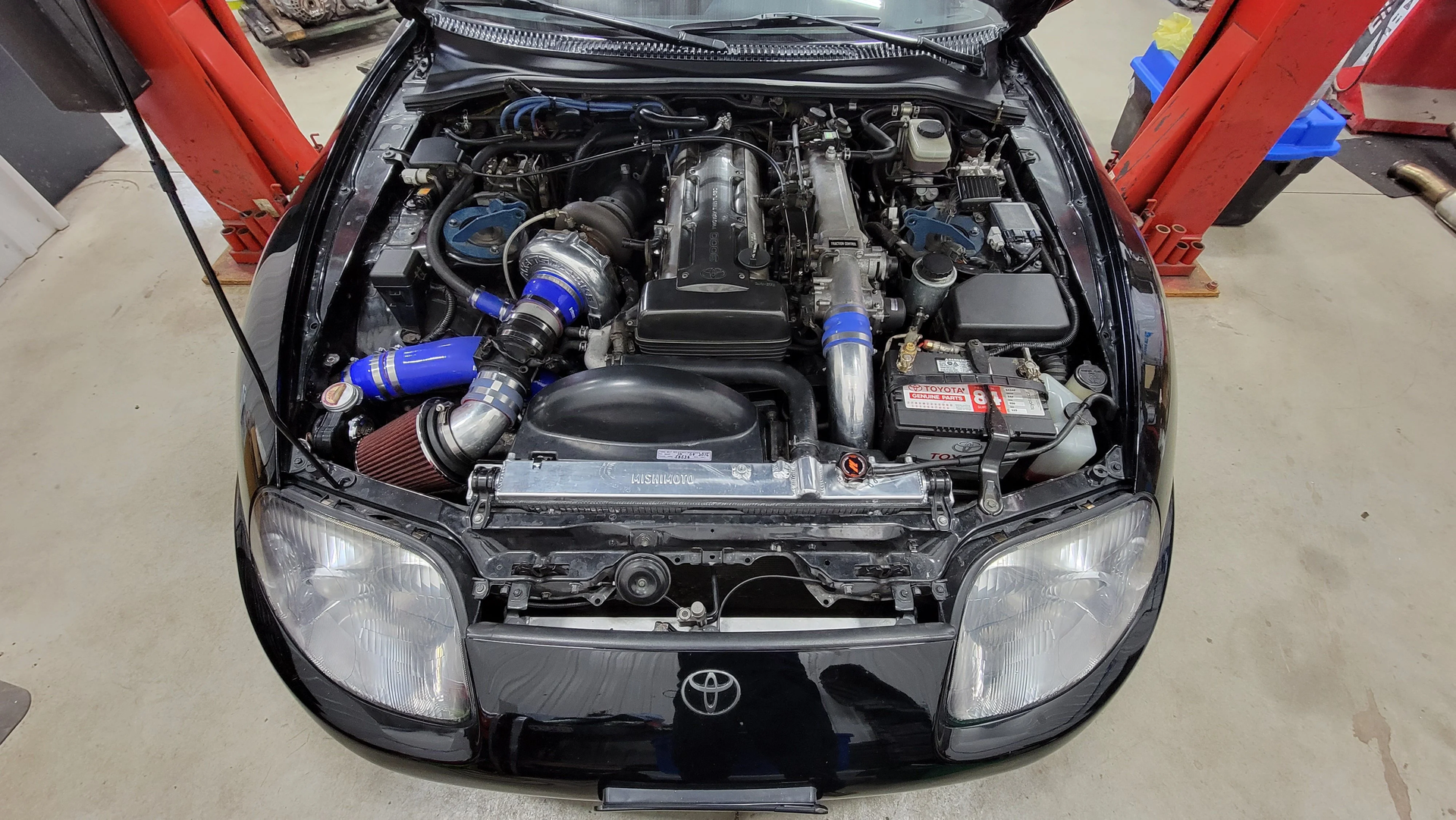
How to Install the G40-1150 on a 2JZGTE VVTI: Step-by-Step Overview
This is a professional-level installation. Budget 15–20 hours of labour if you have prior experience. Budget more if this is your first turbo swap.
- Remove the factory sequential turbo system — both CT20 turbos, connecting pipes, external wastegate actuator, and dual-path exhaust manifold.
- Install the new single-turbo manifold — torque to manufacturer spec, use copper anti-seize on all exhaust studs.
- Mount the G40-1150 to the manifold — do not tighten the turbine housing bolts fully until oil and coolant lines are connected.
- Run -4AN oil feed from the engine gallery with the restrictor fitted — confirm the restrictor is seated before first startup.
- Run -10AN oil return to the sump — ensure the return exits above the oil level to prevent back-pressure.
- Connect coolant lines — water-cooled centre sections require both feed and return lines from the block water jacket.
- Install charge piping and intercooler — ensure all couplers are clamped with T-bolt clamps, not worm-drive clips.
- Install the wastegate and BOV — set initial boost at 20 PSI for the first dyno pull.
- Install the engine management system and wire the VVTi solenoid — this step requires a wiring harness specialist if you are not confident with automotive electrics.
- Prime the oil system before first start — crank the engine with the fuel pump relay removed for 10–15 seconds to pre-oil the turbo bearings.
FAQs: G40-1150 2JZGTE VVTI
Does the G40-1150 work on a non-VVTi 2JZGTE?
Yes, the G40-1150 fits both VVTi and non-VVTi variants of the 2JZGTE. The difference is spool onset — the VVTi version spools 200–400 RPM earlier due to active cam timing control. Non-VVTi builds on the G40-1150 typically see full boost at 4,400–4,800 RPM on a 0.95 A/R housing.
What is the spool RPM of the G40-1150 on a 2JZ?
On a 2JZGTE VVTI with a 0.95 A/R housing, a properly tuned VVTi map, and a twin-scroll equal-length manifold, initial boost appears at approximately 3,600–3,800 RPM, with full boost by 4,200–4,400 RPM. These figures assume a built motor with GSC cams and a minimum 44mm wastegate.
How much does a complete G40-1150 2JZGTE build cost in 2026?
A reliable street build in 2026 costs between £6,500–£10,500 including the turbo, supporting mods, ECU, and a professional tune. A full race build targeting 1,000+ WHP — with forged internals, a head rebuild, and premium electronics — runs £15,000–£20,000 in the UK market.
Is the G40-1150 suitable for daily driving a Toyota Supra?
Yes, with the right A/R ratio. A 0.85 or 0.95 A/R G40-1150 on a properly tuned 2JZGTE VVTI is drivable on public roads. Expect mild lag below 3,500 RPM and very strong power from 4,000 RPM onwards. Running 25 PSI on E85 with a Link ECU gives a reliable, streetable calibration. Do not attempt to daily-drive a 1.19 A/R setup — the lag makes it unpleasant below 5,000 RPM.
What ECU is best for a G40-1150 2JZGTE VVTI?
The Link ECU Fury and Haltech Elite 2500 are the two most widely used ECUs for this build in 2026. Both support VVTi cam control, boost-by-gear, wideband oxygen sensor integration, and launch control. The AEM Infinity 6 is a strong third option for builders in the US market.
G40-1150 or G40-900: Which should I choose?
Choose the G40-900 if your target is below 850 WHP and you want the fastest possible spool on a street car. Choose the G40-1150 if you are targeting 900–1,150 WHP on a built motor. Both turbos share the same frame size and are directly interchangeable — the housing dimensions are identical.
Final Verdict
The G40-1150 is the turbocharger that makes the most sense for a 2JZGTE VVTI build targeting 800–1,100 WHP. It is not the cheapest option, but it is the most capable in its size class, with modern aerodynamics, a robust bearing system, and a power ceiling that only the most aggressive built engines will ever reach.
Choose your A/R ratio based on your use case. Prioritise the fuel system and ECU before anything else. Do not skip the oil restrictor. Get a proper VVTi-aware tune from a shop that has done this combination before.
Done right, this is one of the most rewarding performance builds available for a street or track car in 2026.
For more in-depth automotive guides and performance build content, explore the Big Write Hook Auto section and the Understanding the G40-1150 2JZGTE VVTI Turbo overview published by Lewis Calvert.
References
- Garrett Motion — G-Series G40-1150 Official Product Page
- Garrett Motion — George Kiriakopoulos G40-900 Dyno Data on 2JZGTE VVTI
- Extreme Turbo Systems — G40-1150 1.06 A/R V-Band Specification Sheet
- Full Race Motorsports — G40-1150 Product Overview
- Brewed Motorsports — 2JZ Tuning Guide (Injectors, Fuel Systems, ECU)
- Brewed Motorsports — Radium Engineering Top-Feed Fuel Rail for 2JZGTE
- SupraForums — G40-1150 vs PTE6766 Community Discussion Thread
- ATP Turbo — G40-1150 T4 Divided 0.85 A/R Turbocharger Unit
